
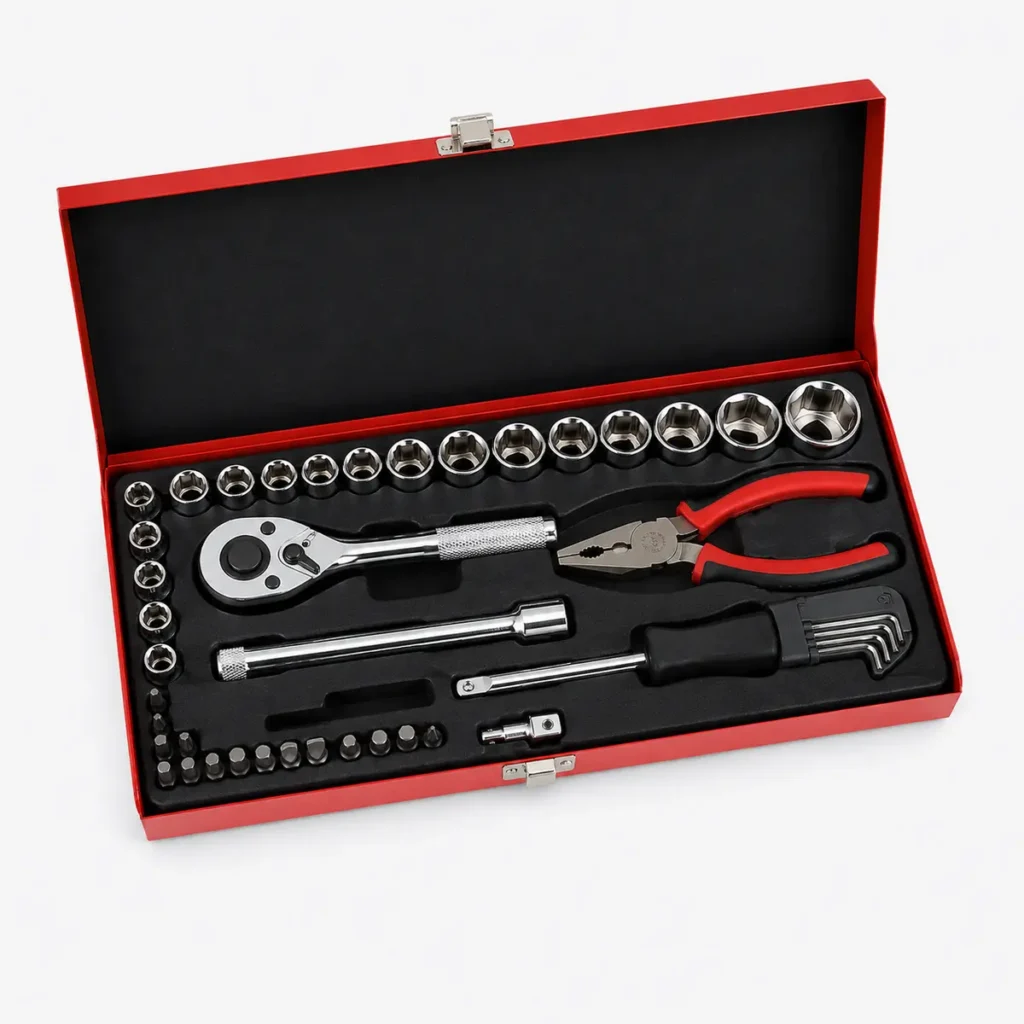
A 3/8 socket set is a collection of sockets built around a nominal 3/8-inch square-drive connection. The fraction describes the interface between a socket and its drive tool, not the size of the nut or bolt. A set can therefore have a 3/8-inch drive and metric socket openings at the same time.
For importers, distributors, and private-label brands, the important question is what the assortment actually contains. Two sets with similar piece counts can differ substantially in size coverage, socket depth, ratchet construction, documentation, and replacement support. This guide explains how to compare manual socket sets through an exact specification rather than a headline number.
Scope: a specification and procurement guide for manual hand-tool assortments. Product information was checked in September 2026. No independent hands-on testing or brand ranking is claimed.
What Does 3/8 Mean on a Socket Set?
A socket has two distinct interfaces: the square-drive opening on one end and the fastener profile on the other. A description such as “3/8-inch drive, 13 mm, 6-point” identifies three separate properties. Confusing these fields can result in an inaccurate catalog or an assortment that does not match the intended specification.
| Specification | Meaning | Example |
|---|---|---|
| Drive size | Nominal square-drive connection | 3/8 inch |
| Socket opening size | Nominal fastener size | 13 mm |
| Measurement system | Units for the socket opening | Metric or SAE/inch |
| Point count | Internal fastener profile | 6-point or 12-point |
| Depth category | Socket body configuration | Standard/shallow or deep |
The exact conversion of 3/8 inch is 9.525 mm, but that does not make a 3/8-drive socket a 9.525 mm fastener socket. Likewise, a 3/8-inch SAE socket opening and a 3/8-inch drive describe different ends of the component. Keep both fields visible in specifications.
3/8 vs. 1/4 vs. 1/2 Drive: Compare the Interface First
These fractions identify different drive families. A 3/8-inch drive sits between 1/4 inch and 1/2 inch in nominal interface size. They are not universal strength grades, and none establishes a single safe torque limit for every socket, ratchet, or attachment in that family.
| Drive family | Nominal interface size | Procurement implication |
|---|---|---|
| 1/4-inch drive | 6.35 mm | Record it as a separate drive family in a mixed assortment |
| 3/8-inch drive | 9.525 mm | Confirm that each socket and specified drive component matches the stated family |
| 1/2-inch drive | 12.7 mm | Do not treat the larger interface as a substitute for component-level specifications |
A professional comparison starts with the product brief: target fastener sizes, assortment purpose, dimensional requirements, and applicable documentation. The largest drive or the highest piece count does not automatically produce the most suitable retail range.
Metric or SAE: Require an Exact Size List
A 3/8 metric socket set has millimeter-sized socket openings. A 3/8 SAE socket set has inch-sized openings. Both can share the same drive size. A mixed set includes both measurement systems, but the contents need to show how much coverage each receives.
A range such as “6–22 mm” establishes the endpoints, not every included size. A “no-skip” claim needs a stated sequence and an exact component list. For inch sizes, the intended increments also need to be clear; there is no useful no-skip claim without a defined series.
Our metric vs. SAE socket set guide explores measurement-system planning in more detail. For this drive-specific comparison, keep size, depth, and profile in separate columns so omissions remain visible.
Why Piece Count Can Be Misleading: A Real Catalog Example
The listed Nexus ToolPal 38-piece 3/8-inch drive socket tool set contains 15 metric sockets: 6, 7, 8, 9, 10, 11, 12, 13, 14, 15, 16, 17, 18, 19, and 22 mm. The remaining pieces include bits, hex keys, a ratchet, and other hand-tool components.
This illustrates two important distinctions. “38-piece” does not mean 38 sockets. Also, the listed 6–22 mm coverage is not a continuous one-millimeter sequence: 20 mm and 21 mm are absent. That does not make the assortment defective; it makes the exact list essential to deciding whether the configuration matches a brief.
The same logic applies to any supplier. A compact mixed hand-tool kit and a socket-focused assortment serve different merchandising purposes, even if their outer cases look similar. Compare contents against the intended product category before comparing prices.
Standard vs. Deep and 6-Point vs. 12-Point
Socket depth is a dimensional specification
Standard or shallow sockets have shorter bodies than deep versions within a comparable product family. However, “deep” alone does not communicate overall length, internal clearance, or outside diameter. When dimensions matter to the product brief, request the actual drawing or dimensional table.
If the same size appears once in standard depth and once in deep depth, that is two socket configurations but one nominal opening size. Both counting methods are useful, provided the catalog makes clear which is being reported.
Point count is a profile specification
Six-point sockets have a hexagonal internal profile; twelve-point sockets have a different internal geometry with more indexing positions. Record the intended fastener profile rather than treating the higher number as a higher quality grade. Design, dimensions, and manufacturing consistency still matter.
For a mixed-profile assortment, identify the profile for each component. A label on the front of the case is insufficient if the bill of materials contains exceptions.
Ratchet Quality: Look Beyond the Tooth Count
Tooth count is one useful ratchet descriptor, but it does not establish overall strength, service life, or manufacturing consistency. Head dimensions, engagement design, switching behavior, socket retention, and replacement-part support are separate questions.
The professional approach is to specify the required characteristics and how they will be verified. A high tooth count cannot compensate for unclear acceptance criteria, inconsistent markings, or a ratchet model that changes between the approved sample and production.
Avoid publishing a generic maximum torque for “all 3/8 ratchets.” Any documented rating belongs to the specified component and its stated conditions. This guide does not assign operating limits or provide testing procedures.
Material Claims and Quality Evidence
“Chrome vanadium” describes an alloy family, not the complete quality of a finished socket. Material identity, heat treatment, dimensions, finish, and finished-product performance need different evidence. A polished surface cannot verify what happened during heat treatment.
| Claim or requirement | Useful evidence to request | What it cannot establish alone |
|---|---|---|
| Specified steel grade | Traceable material documentation linked to the production lot | Finished-tool performance |
| Consistent heat treatment | Process records and relevant inspection results | That every unit is identical |
| Dimensional conformity | Inspection report tied to an approved drawing | Service life under all conditions |
| Performance conformity | Report identifying product, method, acceptance criteria, and results | Unlimited strength or lifetime durability |
| Corrosion resistance | Defined finish requirement and relevant test report | An exact number of years in every environment |
ASME B107.110 addresses performance and safety requirements for socket wrenches, handles, nutdrivers, and attachments. A supplier citing a standard should identify the edition, applicable product scope, and supporting results. A standard reference alone is not evidence that a particular production batch passed the relevant requirements.
For the broader verification process, see our hand-tool quality-control checklist. Keep the approved sample, agreed specification, and production records connected to the same item and revision.
A Better Way to Compare Two Quotations
Normalize the specification before evaluating the price. Otherwise, a lower quotation may simply describe fewer required sockets, a different case, or a different inspection scope.
Use three steps: define mandatory requirements, identify unresolved differences, and only then compare commercial terms. This prevents an attractive unit price from masking a configuration mismatch.
| Comparison field | What to record |
|---|---|
| Socket assortment | Every size, measurement system, depth, profile, and quantity |
| Ratchet and accessories | Model or drawing reference, drive size, and exact quantity |
| Materials and finish | Agreed specifications and verification evidence |
| Storage | Case material, layout, component identification, and retention requirements |
| Branding | Marking location, artwork revision, and packaging language |
| Quality acceptance | Inspection scope, acceptance criteria, and report requirements |
| Commercial scope | Order quantity, packaging basis, delivery terms, and replacement policy |
Illustrative example: a 40-piece set contains 18 sockets, while a 32-piece set contains 24 sockets. Neither is automatically better. If the brief requires 22 specific socket configurations, the deciding evidence is which set contains those 22 configurations—not which package has the larger number. These figures are hypothetical, not measurements of listed products.
Replacement availability also affects the long-term value of an assortment. Ask whether individual sockets, ratchets, and cases have stable item references. A clear replacement policy is more informative than a broad warranty headline without exclusions or a defined claims process.
OEM and Private-Label Details Worth Confirming
For a private-label manual socket set, lock the component list before finalizing the case insert and packaging artwork. A late size change can affect labels, layout, product photographs, and carton documentation at the same time.
Agree how proposed substitutions will be reviewed. A component with the same nominal size may still differ in length, profile, finish, or marking. Record the approved revision so repeat orders do not silently drift away from the original assortment.
Nexus ToolPal’s listed 38-piece configuration provides a starting point for discussion; any requested changes, MOQ, lead time, and verification scope require project-specific confirmation. Share the exact assortment brief through our quotation page to request a comparable proposal.
Frequently Asked Questions
What is a 3/8 socket set?
It is an assortment of sockets with a nominal 3/8-inch square-drive connection. The socket openings can be metric, SAE/inch, or a combination of both.
Does 3/8 drive mean a 3/8-inch bolt size?
No. Drive size describes the connection to the ratchet or other drive component. The socket opening size is a separate specification.
Is a 3/8 socket set metric or SAE?
It can be either. Check the exact contents rather than inferring the measurement system from the drive size.
How many sockets should a set contain?
There is no universal correct number. A useful assortment covers the defined size, depth, and profile requirements. Total pieces may also include bits, handles, and other accessories.
Are chrome sockets automatically impact-rated?
No. Drive size, alloy wording, and appearance do not establish an impact rating. Manual and impact-rated products are separate specification categories; rely on the manufacturer’s explicit classification.
What is the best 3/8 socket set for a private-label range?
The strongest candidate is the one that meets the documented assortment and quality requirements, with clear production consistency and replacement support. A best-for-everyone claim would ignore those differences.
Conclusion: Judge a 3/8 Socket Set by Its Verified Contents
A well-specified 3/8 socket set begins with the right distinction: drive size is only one part of the product. Compare exact socket coverage, depth and profile, ratchet details, quality evidence, packaging, and replacement support before judging value. For a private-label program, turn those requirements into an approved component list and a controlled specification so the delivered assortment matches the promise made to your customers.