A buyer asks for a cutter for “6 mm cable.” Before quoting, ask what the blades will meet: a single wire, an electrical conductor or twisted steel rope. Each has a different capacity rating.
For a cable cutter vs wire rope cutter decision, start with the metal and how the cable is built.
If the customer asks for a wire cutter, check whether they mean diagonal cutting pliers for individual wires.
Cable cutter vs wire cutter: which tool fits the workpiece?
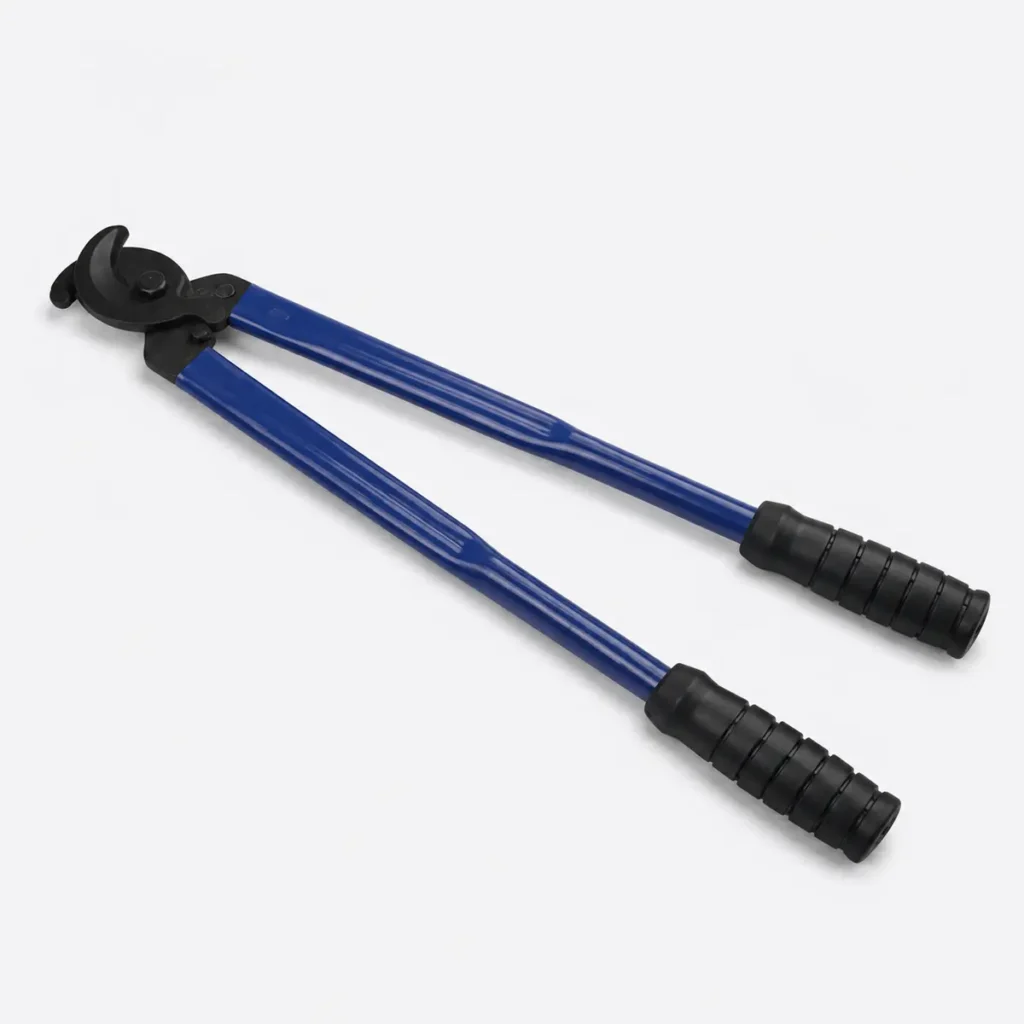
A cable shear gathers strands between curved blades. A diagonal cutter has short, angled edges for individual wires. A rope cutter must support the rope as it cuts so the end can enter its fitting.
| Workpiece | Tool to check | Read this rating |
|---|---|---|
| Individual metal wire | Diagonal wire cutter | Wire diameter and hardness class. |
| Stranded electrical conductor | Cable cutter or cable shears | Copper or aluminum, strand class, conductor area and any diameter limit. |
| Steel wire rope | Wire rope cutter | Rope diameter, grade, construction and coating. Confirm the maker covers the intended rope. |
Why a 3 mm wire can be too hard for the same pliers
The KNIPEX 70 01 160 data sheet gives three limits: 4 mm for soft wire, 3 mm for medium-hard wire and 2 mm for hard wire.
At 3 mm, medium-hard wire is at the listed limit. Hard wire of the same diameter exceeds its row by 1 mm. For an unmarked sample, ask the wire supplier to identify the material and grade.
Wire rope and cable cutters: when can one tool do both jobs?
Some tools carry separate ratings for rope and conductors. Read the row for the material in hand. These examples use the makers’ published specifications.
| Model | Published rating | Buying decision |
|---|---|---|
| KNIPEX 95 12 200 | Multiple-stranded copper: 70 mm² and Ø20 mm. Steel wire and hard-drawn copper excluded. | Check conductor type and diameter together. |
| KNIPEX 95 61 190 | Rope: Ø5 mm. Fine-stranded copper: Ø6 mm. Multiple-stranded copper: 10 mm² / Ø7 mm. Piano wire: Ø2.5 mm. | A 6 mm steel rope exceeds the rope limit by 1 mm. |
| Klein Tools 63050 | Soft copper: 2/0 AWG. Aluminum: 4/0 AWG. | Steel and ACSR are excluded. |
| Klein Tools 63060 | Copper: 600 MCM. Aluminum: 750 MCM. | The ratchet helps with effort. The steel and ACSR exclusions still apply. |
For the 6 mm inquiry, the 95 61 190 is a candidate for the listed fine-stranded copper. For 6 mm steel rope, quote a different model with a documented rating for that rope.
How to read conductor area, cable diameter and rope construction
Record the unit and what was measured. A conductor area helps size the electrical conductor. The outside diameter tells you the space the finished cable takes up at the jaws.
The Southwire Power Cable Manual explains how strands contribute to conductor area. Insulation, fillers and spaces between strands affect finished diameter.
For example, four 25 mm² cores contain 100 mm² of nominal conductor area in total. To select a cutter for the whole cable, obtain its finished diameter and the maker’s multicore rating.
In the Southwire AWG and kcmil table, 2/0 AWG is about 67.4 mm². MCM and kcmil both mean thousands of circular mils. Keep the maker’s original units when quoting a limit.
For 7×7 rope, the figures describe seven strands of seven wires each.
Request the bare rope diameter and, if coated, its finished diameter. A 7×7 designation alone gives neither measurement.
Check for a steel core or armor
Southwire’s ACSR specification identifies a steel core inside an aluminum conductor.
Check the complete construction before applying an aluminum rating. Follow the same rule for steel armor and messenger wire.
Selecting a Nexus ToolPal cutter for a sample order
Use the website SKU and catalog item together on an inquiry. The two product pages below publish different kinds of dimensions.
The CCUT-01 heavy-duty cable cutter lists four tool lengths and cutting areas: 14 in / 95 mm², 18 in / 150 mm², 24 in / 240 mm² and 36 in / 500 mm².
The table gives one area per length. Send the conductor material, strand class and cable diameter so the supplier can confirm the applicable size in writing.
The WRC-01 wire rope cutter is catalog item JT-VI-2. Its 10-inch size is the tool length. The public table gives no maximum rope diameter. Ask for the limit for your rope grade and construction.

What to include in the RFQ and sample check
For wire, send its grade and diameter. For electrical cable, give the metal, strand class, core count, area per core and finished diameter.
For rope, give its grade, construction, core and coating.
Identify the next operation. For electrical cable, check if the end can be stripped and placed in the specified terminal.
For rope, record loose strands and whether the end enters the intended sleeve without rework.
Once the supplier confirms compatibility, compare samples on the same stock. Record the tool model, cable part number, cut count, end condition and space needed to open the handles.
Use isolated, verified de-energized cable or unloaded, secured rope. Follow the CCOHS guidance for cutting tools on eye protection, stable support and tool limits.
Comfort grips provide no assurance of electrical insulation.
Add the acceptance criteria to your hand tool RFQ checklist. A sample result applies to the tool and stock evaluated.
For bulk approval, agree which stock, finish and cut-end checks the supplier will repeat.
Questions about wire, cable and rope cutters
These answers explain which entry to look for when a catalog uses the word “cable” for several materials.
What is the difference between a cable cutter and a wire cutter?
A cable cutter shears a conductor bundle. A diagonal wire cutter clips individual wires within a stated diameter and hardness range. Check the exact model against the material.
Can one cutter cut both steel wire rope and copper cable?
Yes, when the maker lists both. KNIPEX 95 61 190 lists 5 mm for wire rope and 6 mm for fine-stranded copper. Select the limit for the stock in hand.
What does a 10-inch wire rope cutter rating tell me?
On the WRC-01 listing, 10 inches is the tool size. Ask the supplier for a separate diameter limit for the rope grade and construction you plan to cut.
To request a cutter quote, send the workpiece specification and target quantity. Include a photo or drawing with dimensions if the cable has a coating, armor or an unusual core.