
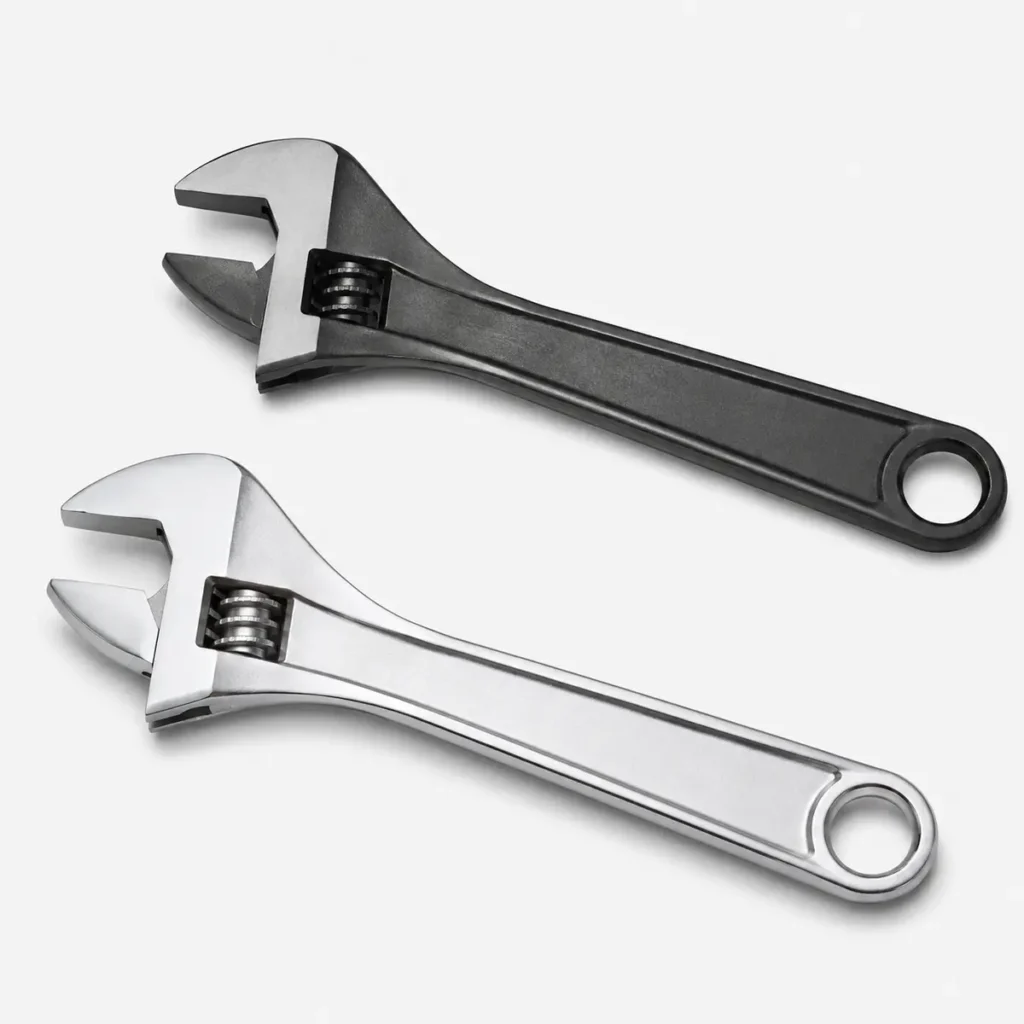
Adjustable wrench sizes describe two different things: the length of the tool and the maximum opening of its jaws. A 10-inch wrench does not grip a 10-inch nut. To choose a usable size, match the fastener’s width across flats to the model’s published jaw capacity, then check whether the head and handle can reach, seat and turn in the available space.
For hardware wholesalers and industrial tool buyers, this distinction affects both assortment planning and purchasing specifications. Two wrenches sold as “8 inch” can have different openings, head dimensions and applications. This guide uses identifiable manufacturer specifications to explain those differences and shows how to turn a customer’s job into a size requirement.
What does an adjustable wrench size actually mean?
- Nominal length: the catalog size, such as 6, 8, 10 or 12 inches. Treat this as a product class; check the listed overall length in millimeters for drawings, storage and access.
- Jaw capacity: the maximum published gap between the gripping faces. Compare it with the fastener’s across-flats dimension, not its thread diameter or the distance across its corners.
- Access dimensions: jaw thickness, head thickness, head width and the space required to position and move the handle. Capacity alone does not describe these.
An M-size designation describes a metric thread, not the wrench opening. Similarly, a pipe’s nominal size does not tell you the width of a fitting’s hexagon. Obtain the fastener or fitting drawing, or measure the two opposing flats. An adjustable wrench can fit both metric and fractional-inch flats within its capacity; a scale marked in one system does not restrict it to that fastener system.
Adjustable wrench sizes chart: real model dimensions
The table below reproduces selected dimensions from BAHCO’s standard 80-series specifications and BAHCO’s thin-jaw 9029-T/9031-T specifications, checked in October 2026. These are model-specific catalog values, not universal capacities for every wrench of that length and not independent test results.
| Model | Catalog length | Overall length | Maximum opening |
|---|---|---|---|
| BAHCO 8070 | 6 in | 155 mm | 20 mm |
| BAHCO 8071 | 8 in | 205 mm | 27 mm |
| BAHCO 8072 | 10 in | 255 mm | 31 mm |
| BAHCO 8073 | 12 in | 305 mm | 34 mm |
| BAHCO 8074 | 15 in | 380 mm | 44 mm |
| BAHCO 8075 | 18 in | 455 mm | 53 mm |
| BAHCO 9029-T, thin jaw | 6 in | 170 mm | 32 mm |
| BAHCO 9031-T, thin jaw | 8 in | 218 mm | 38 mm |
Notice the overlap: a short, wide-opening design may accept a wider fastener than a longer conventional design. That does not establish equal strength, equal leverage or equal suitability for a job. The table is a capacity reference; performance approval requires the specified tool and application conditions.
How large a fastener can it actually grip?
Start with the actual across-flats measurement. If a drawing calls for 32 mm flats, a wrench whose maximum opening is 29 mm cannot fit. A published 34 mm opening passes the initial capacity check, but the jaws must still seat fully and the head must clear surrounding components. Do not assume a catalog maximum proves reliable operation in every installation.
Be careful at unit boundaries. A 1¼-inch across-flats dimension is 31.75 mm; a nominal 31 mm maximum is insufficient. A 1½-inch dimension is 38.1 mm, so a product listed only as 38 mm should not automatically be approved for it. Ask the manufacturer to confirm the required fractional-inch fit instead of rounding the fastener down or assuming unpublished extra travel.
Do not create a blanket rule such as “always add 2 mm” to every opening requirement. Specify the largest actual fastener, its dimensional tolerance and the required fully seated fit. The supplier should confirm the relevant model and demonstrate the fit on the agreed sample or gauge. Never loosen the adjustment deliberately to create working clearance between the jaws and the flats.
A Nexus ToolPal example: why the exact SKU matters
Our European-Type Wide-Handle Adjustable Wrench page lists the following WB-03 sizes. These are our published product specifications, provided separately from the BAHCO reference data; they are not claims of identical design or performance.
| Nexus ToolPal SKU | Catalog length | Full length | Opening capacity |
|---|---|---|---|
| WB-03-8 | 8 in | 204 mm | 24 mm |
| WB-03-10 | 10 in | 254 mm | 29 mm |
| WB-03-12 | 12 in | 305 mm | 34 mm |
For a 30 mm across-flats requirement, WB-03-10 does not pass the opening check, while WB-03-12 does. The purchasing decision must then consider access and the application’s load requirements. A different manufacturer’s 10-inch model may have another opening, which is why an RFQ that says only “10-inch adjustable wrench” leaves a material specification gap.
Choose length after checking capacity and access
A useful selection sequence is fastener geometry → opening → head access → handle movement → load suitability. Starting with the longest handle can produce a tool that opens far enough but cannot be positioned or turned.
6- and 8-inch classes: compact access and portable kits
Consider these classes where portability and nearby obstructions matter. A standard compact wrench and a compact wide-opening wrench serve different needs, so record both length and opening on the stock card. A larger opening on a short tool is an access option; it does not justify applying the same force as with a larger tool.
10- and 12-inch classes: compare the working envelope
For general maintenance assortments, compare these classes against the actual installed equipment. Check whether the extra length allows a useful grip or collides with a cabinet, hose or adjacent assembly. Where the head fits but the handle cannot complete and reset a stroke, a different tool form may be more effective than another length of adjustable wrench.
15- and 18-inch classes: justify the size with a defined job
Larger tools need more carrying, storage and movement space. Industrial purchasers should obtain the application requirement and manufacturer guidance rather than infer an acceptable torque from handle length. For distributors, stock these sizes in response to a documented customer need instead of assuming every size extension improves the range.
Access means more than a thin jaw
Ask for a dimensioned drawing that separates the gripping jaw section from the thicker head and adjustment mechanism. A thin tip may enter a narrow gap while the rest of the head stops the wrench before the gripping faces are fully seated.
For example, BAHCO lists a 4.5 mm jaw thickness and 13.4 mm head thickness for the 9031-T. Those two dimensions answer different clearance questions. The same official page also gives a 38 mm opening; none of the three numbers substitutes for the other two. Refer to the manufacturer’s drawing to identify exactly where a dimension is taken.
- Approach: can the head reach the flats without removing another component?
- Seating: can the gripping faces contact the flats fully, without being tilted or supported only at their tips?
- Movement: can the handle turn far enough, and can the tool be repositioned for the next stroke?
- Hand clearance: is there room for a controlled grip, including required work gloves?
For an industrial trial, use the real assembly or a representative fixture with the relevant obstructions. A photograph of a wrench around a loose nut demonstrates opening fit only. It does not validate access inside the customer’s machine.
Three selection cases for wholesale and industrial buyers
| Customer requirement | Initial screening | Next decision |
|---|---|---|
| Portable service kit; mixed fasteners up to 24 mm across flats | Check each proposed compact SKU’s listed opening | Trial the largest and smallest required fasteners; verify seating and handle clearance |
| Maintenance task with 32 mm flats near an obstruction | Reject models with openings below 32 mm; compare conventional and compact wide-opening designs | Check head dimensions and trial the assembly; obtain confirmation of load suitability |
| Repeated tightening to a specified torque | An opening-size match is insufficient | Select a suitable torque-controlled tool and procedure; check any adapter correction requirements |
For repeated work on a known fastener, consider a correctly sized ring wrench or socket where access permits. A general adjustable wrench remains useful for varied sizes and holding tasks, but it does not measure torque. Our ratcheting wrench guide covers another tool option when repeated repositioning is the main problem.
Build a wholesale range around distinct jobs
Avoid treating every added length as a new benefit. Group customer needs into portable service, general workshop work, narrow-access tasks and larger equipment maintenance. Then compare candidate SKUs by their opening, dimensions and demonstrated application coverage. A compact wide-opening model may fill a gap that another conventional length does not.
For each listing, show nominal length, actual overall length, maximum opening and the exact SKU. Where access is a selling point, include a dimensioned head drawing. Label a “wide handle” separately from a “wide opening”: one describes the grip, the other describes jaw capacity. A photograph or a handle-style name cannot establish the opening.
Do not publish a fixed stock ratio without your own sales and customer data. Pilot the proposed assortment, record requests for missing sizes and investigate returns by cause: insufficient opening, poor access, unsuitable tool choice or a product defect. Those observations are more useful for the next order than a generic claim that one length is “best.”
What to specify when ordering adjustable wrenches
Keep the size section of an RFQ specific enough to compare offers. For each line, request:
- Exact SKU or approved drawing revision, nominal size and actual overall length.
- Required fastener across-flats range, including the largest actual dimension and relevant tolerance.
- Guaranteed minimum opening, with the supplier’s measurement method and acceptance tolerance.
- Jaw thickness at defined locations, head thickness and other dimensions critical to the assembly.
- Application, access photographs or drawings, and any operating-load requirement for supplier review.
- Applicable performance standard and edition, test conditions and evidence for the exact model.
- Sample fit and access approval before accepting a proposed replacement model.
BAHCO’s reference pages list standards including ISO 6787. That is a statement about those products, not certification of another supplier’s wrench. For an OEM purchase, identify the applicable requirement explicitly and request matching evidence. Our hand tool RFQ checklist covers commercial and packaging details; the torque and proof-load testing guide explains how to review strength evidence separately from dimensions.
Fit and safe use: keep the limits clear
The Canadian Centre for Occupational Health and Safety (CCOHS) wrench guidance advises using the correct jaw size, seating the wrench properly, and keeping the adjustment secure. It also explains the turning direction relative to the permanent jaw. Follow the tool maker’s instructions for the exact design.
Inspect the mechanism and jaws, readjust for a snug fit and apply controlled force. Do not extend an ordinary wrench handle with a pipe or strike it to gain force. A longer handle or larger opening is not permission to exceed a tool’s intended use. For prescribed tightening torque, use the appropriate torque-controlled equipment rather than estimating from hand effort.
Frequently asked questions about adjustable wrench sizes
What size adjustable wrench should I buy first?
Start with the largest fastener across flats and the available working space. Then compare exact model specifications. An 8- or 10-inch label alone cannot establish whether the wrench will fit the job. For a wholesale range, customer application data should determine the first sizes.
How wide does an 8-inch adjustable wrench open?
There is no single universal opening. In the published examples above, Nexus ToolPal WB-03-8 is listed at 24 mm, BAHCO 8071 at 27 mm and BAHCO 9031-T at 38 mm. Use the exact SKU’s technical data rather than transferring a capacity from another product.
Can a 10-inch adjustable wrench grip a 32 mm nut?
Only if that model’s confirmed opening and fit allow it. The 10-inch models listed in this guide do not meet a 32 mm opening requirement. Another design may differ, so check its specification and verify access before approval.
Does the maximum opening tell me the maximum torque?
No. Jaw capacity is a geometric dimension. Allowable loading depends on the tool’s design and applicable manufacturer instructions or test requirements. Never convert maximum opening or overall length into a torque rating.
Choose adjustable wrench sizes from the job outward
For wholesale and industrial purchasing, the right adjustable wrench sizes combine verified opening capacity, suitable length, full jaw contact and usable access. Record the fastener’s across-flats dimension, compare exact models and approve the fit on the actual application. To discuss a Nexus ToolPal selection, send your required fastener sizes, access constraints and quantity for each SKU so the quotation can be based on a defined specification.