
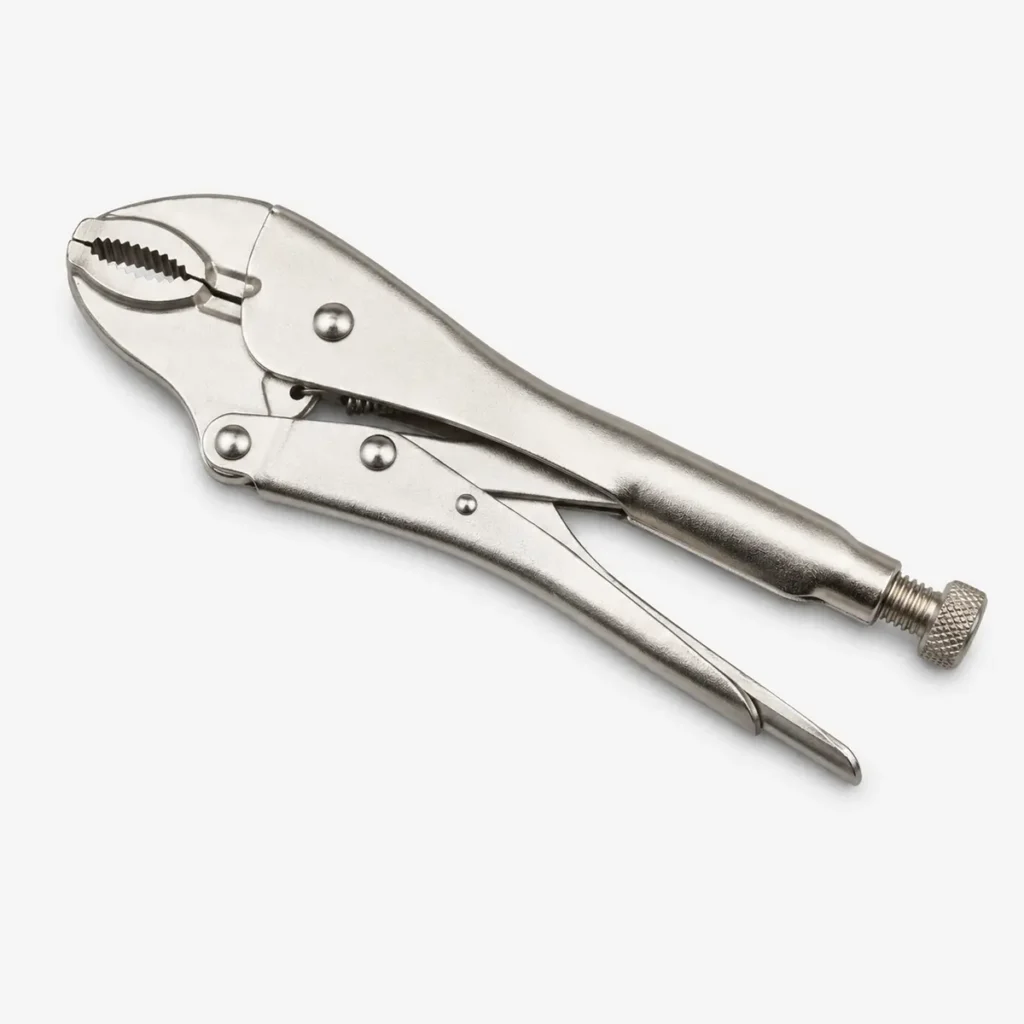
Curved vs straight jaw locking pliers is primarily a choice about workpiece shape and contact. Start with curved jaws for round rods and suitable tubing, and straight jaws for flat stock or accessible flat faces. Then check the exact tool on the actual material. A built-in wire cutter is an optional second function, not evidence of better gripping or approval to cut every type of wire.
For plier buyers and maintenance-tool distributors, three questions make the selection clearer: what shape must be held, what surface damage is acceptable, and does the user actually need cutting? This guide compares jaw selection and cutter requirements using official IRWIN specifications and two published Nexus ToolPal configurations. It is a specification-based guide, not a hands-on brand ranking.
Curved vs straight jaw locking pliers: quick selection
| Workpiece or task | Starting jaw choice | Important limit |
|---|---|---|
| Solid round rod or suitable round section | Curved jaw | Confirm the diameter and stable contact |
| Flat bar or plate edge | Straight jaw | Confirm contact at the actual thickness |
| Square section | Straight jaw is a useful starting point | Check contact, access and permitted marking |
| Thin-wall tubing | Curved jaw may match the shape | Locking pressure can still crush or distort it |
| Finished, soft or decorative surface | Neither serrated design by default | Consider an appropriate non-marring holding method |
| Frequent wire cutting | A cutter rated for the material and diameter | The locking plier’s opening is not a cutting rating |
These are starting points, not exclusive rules. A curved design can have straight contact surfaces near the tip, and some curved or universal jaws grip angular stock. Inspect the actual profile instead of treating the product name as a complete description.


Real catalog data: the same opening can serve different jobs
IRWIN’s European Original-series pages list these examples. The curved-jaw wire-cutter range and straight-jaw range show the same published capacities at the two lengths below:
| Jaw / feature | Exact EU item reference | Catalog size | Listed capacity |
|---|---|---|---|
| Curved, with wire cutter | 7WR / T0702EL4 | 7 in / 175 mm | 38 mm |
| Straight | 7R / T0302EL4 | 7 in / 175 mm | 38 mm |
| Curved, with wire cutter | 10WR / T0502EL4 | 10 in / 250 mm | 48 mm |
| Straight | 10R / T0102EL4 | 10 in / 250 mm | 48 mm |
Source: the two official regional product tables, checked October 2026. These are catalog values, not our measurements. Keep the item references and market version with the data; do not transfer them to another series or supplier.
The purchasing lesson is that an equal opening figure does not establish equal contact on a rod and a flat strip. Nor is opening capacity a holding-force, working-torque or cutting-wire rating. Geometry and the intended operation must still be checked.
When curved jaws are the better starting point
A curved gripping pocket can accommodate the outside of a round section, giving a more suitable starting geometry than relying on straight jaws to pinch the same part. IRWIN describes its curved range for multiple surface shapes, including round pipes. That flexibility does not make every curved design appropriate for every diameter.
For round material, record the outside diameter, material and whether it is solid or hollow. On tubing, also record wall thickness and the permitted deformation. Two pieces with the same outside diameter can react very differently to the same adjustment when one is solid and the other is thin-wall tube.
Check whether the teeth engage securely without the workpiece riding out of the gripping area. Do not assume a fixed number of contact points or a particular holding force merely from the word “curved.” Tooth form, wear, cleanliness, jaw alignment and adjustment all affect the result.
If the task requires preserving a plated tube, a soft metal part or a cosmetic surface, tooth marks can make the tool unsuitable even when it holds securely. An appropriate soft-jaw fixture or other holding method may be needed. Adding improvised padding changes contact and usable capacity and should not be treated as an automatically approved solution.
When straight jaws make more sense
Straight contact faces are a useful starting point for flat bar, accessible plate edges and square stock. IRWIN’s straight-jaw description specifically identifies contact on flat, square and hex material. For flat stock, the dimension between the gripping faces is often the material thickness in the chosen orientation, not the width of the strip.
Check jaw alignment at the actual clamped thickness. An adjustable locking mechanism does not mean the faces remain perfectly parallel at every setting. The goal is stable, appropriate contact without the part tilting or being held only by an unintended corner.
Straight jaws are not the same as smooth jaws: serrated straight jaws can mark flat steel or softer material. For broad sheet-metal seams, a sheet-metal locking tool with wider faces, or an appropriate clamp, may distribute contact more suitably than ordinary narrow gripping jaws. Choose the required holding footprint rather than simply the straightest-looking jaw.
For ordinary tightening of undamaged fasteners, use the correct wrench or socket. Do not position toothed locking pliers as a universal replacement for a correctly fitting wrench. The CCOHS pliers guidance notes the risk of rounding fastener corners.
What the Nexus ToolPal product data does—and does not—show
Our DL-IV curved-jaw range with wire cutter and DL-XJ straight-jaw range without cutter provide two distinct configurations. The published 10-inch entries illustrate why a buyer should separate known dimensions from missing information:
| Published specification | DL-IV-10 curved | DL-XJ-10 straight |
|---|---|---|
| Catalog size label | 10 in | 10 in |
| Listed full length | 225 mm | 225 mm |
| Listed opening capacity | 40 mm | Not published on this product page |
| Integrated wire cutter | Yes | No |
| Wire material / cutting diameter rating | Not published | Not applicable: no cutter |
Source: Nexus ToolPal product pages, checked October 2026. The nominal size labels and listed full lengths are reproduced as published; they should not be treated as exact inch-to-millimeter conversions. Confirm the approved dimensional specification before ordering.
A missing straight-jaw opening figure is a question to resolve, not permission to copy the curved model’s 40 mm capacity. Likewise, the presence of a cutter does not supply an unpublished wire rating. For a comparison quote, ask for the exact opening and cutting specification where relevant.
Is the built-in wire cutter necessary?
Treat cutting as a separate application decision. In this guide, “wire cutter” means the integrated cutting section, usually near the pivot. It does not mean the gripping teeth or the curved gripping pocket, and it does not imply flush-cutting, cable-cutting or stripping capability.
| Customer’s work | Cutter decision | What to verify |
|---|---|---|
| Holding flat stock; no cutting requirement | A cutter is not necessary for that task | Jaw fit, contact and release |
| Occasional cutting of a specified wire | An integrated cutter may be convenient | Declared material, diameter and suitable access |
| Repeated production cutting | Evaluate a dedicated cutter as well | Cut quality, effort, access and duty |
| Hard wire, spring wire, cable or hardened fastener | Do not approve from “wire cutter” alone | Explicit manufacturer suitability for that material |
Wire diameter alone is insufficient: a rating for one material cannot automatically be applied to a harder wire, a different alloy or a stranded construction. If cutting is part of the customer’s requirement, record the wire specification, diameter, construction and required cut condition, then obtain a model-specific declaration.
CCOHS advises against cutting hardened wire unless the tool is specifically made for it, and warns against hammering cutters or extending handles to gain leverage. Follow the manufacturer’s cutting instructions, use suitable eye protection where fragments may fly, and keep ordinary uninsulated tools away from energized conductors.
A cutter-free model should not be assumed stronger simply because it lacks a cutting notch. Equally, a cutter-equipped model is not automatically a higher-grade gripping tool. Compare relevant product evidence; avoid inventing a strength advantage from a feature count.
Two workpiece examples: separate fit from performance
The following dimensions are illustrative buyer requirements, not results of a test we performed. They show how to turn “round or flat?” into a useful supplier discussion.
| Example requirement | What to measure | Initial selection and remaining check |
|---|---|---|
| Hold a 25 mm diameter solid round bar | 25 mm outside diameter, material and access | Shortlist a curved profile; verify locking contact and the intended holding task |
| Hold a flat strip 30 mm wide × 5 mm thick across its thickness | 5 mm clamping thickness, required contact depth and access | Shortlist straight jaws; verify seating, stability and acceptable marking |
For the strip example, selecting against 30 mm just because it is the larger dimension can misdescribe the application. If the gripping orientation changes, the required opening changes too. Include an orientation photograph or sketch with the inquiry.
A published opening greater than the required dimension is only an initial size screen. Ask whether the tool locks appropriately at that setting, whether the handle and release lever can be operated, and whether the proposed holding load is suitable. Do not calculate allowable holding force from the opening or overall length.
A focused sample check for maintenance-tool buyers
- Use representative round and flat pieces in the sizes the customer actually needs.
- Record the jaw profile, adjustment, workpiece orientation and condition.
- Observe movement or rotation under an agreed, appropriate holding task; keep the conditions with the result.
- Check surface marking and any deformation, especially on hollow or soft material.
- Operate the release repeatedly under the maker’s instructions and check for binding or unintended release.
- If cutting is required, evaluate it separately with the declared wire material and diameter.
This is a fit-and-use review, not a substitute for a specified performance test. For formal acceptance, agree the relevant method, sample identity and limits with the supplier or a qualified test provider. The hand-tool quality-control checklist covers the broader shipment process.
Build the range around jobs, not extra variants
For a distributor serving mixed repair work, curved and straight jaws can fill different needs. A cutter-equipped curved model can be considered for users with a defined occasional cutting task; a straight model without a cutter can address holding-focused work. These are assortment options, not a recommended stock ratio or a claim about market demand.
Before ordering, collect customer requests by workpiece shape, size and cutting requirement. Avoid automatically duplicating every length in every feature combination. Also avoid using “American-type” or “Japanese-type” as a quality ranking: those catalog descriptions do not replace jaw geometry, dimensional data or application evidence.
A concise inquiry should identify the jaw drawing or model, required round diameter or flat thickness, access constraints, acceptable surface marking, cutter requirement, and any declared cutting material and diameter. Add quantity and packaging information through the RFQ brief.
Frequently asked questions
Are curved-jaw locking pliers only for round material?
No. Some designs can also grip angular or flat pieces. Curved jaws are a useful starting point for round sections, but the actual contact and locking behavior on the required workpiece determine suitability.
Are straight jaws non-marring?
No. A straight profile can still have serrated teeth and leave marks. Choose a suitable non-marring holding method when surface damage is unacceptable.
Does a 48 mm jaw capacity mean it can cut 48 mm wire?
No. That capacity describes gripping geometry in the referenced catalog. Cutting requires a separate material- and diameter-specific rating.
Should every locking plier have a wire cutter?
No. Include it when the user has a defined cutting requirement and the model is rated for it. For holding-only work or frequent specialized cutting, another configuration may be more appropriate.
Choose curved vs straight jaw locking pliers by contact and task
The right choice of curved vs straight jaw locking pliers starts with workpiece shape, actual dimensions and acceptable surface effects. Then check locking contact, access and release, and specify a cutter only where its rated capability is useful. Send Nexus ToolPal your round or flat workpiece requirements, cutting needs and quantities for a model-specific selection and quotation.