Choose carbide burr shank sizes by the collet fitted to the grinder. A 1/4-inch shank is 6.35 mm in nominal diameter. If the collet is marked 6 mm, order the shank size its maker specifies.
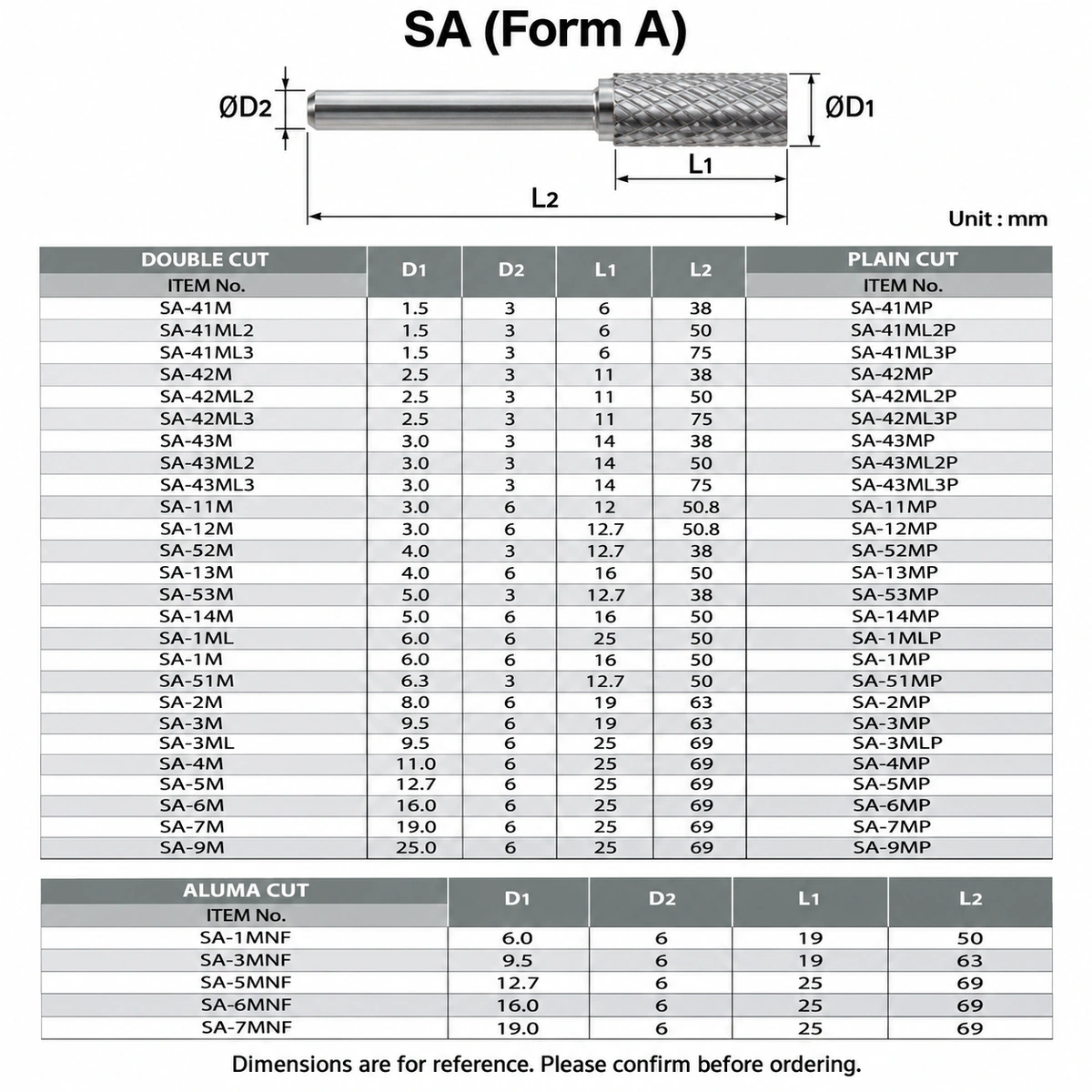
Suppose a customer asks for a “5 mm cylinder burr.” The CB-01 chart has two double-cut items with that head diameter. One has a 3 mm shank and the other a 6 mm shank. Which one would you quote?
How do 6 mm and 1/4-inch carbide burr shanks compare?
A quarter-inch shank is nominally 0.35 mm larger than a 6 mm shank. One inch equals exactly 25.4 mm, so a quarter inch is 25.4 ÷ 4 = 6.35 mm. These figures describe nominal sizes. For fit, use the collet maker’s specification. NIST inch definition
Which size belongs on the purchase order?
Keep the maker’s original designation in the order field and put any conversion in a separate reference column.
| Catalog designation | Reference equivalent | Enter on the order |
|---|---|---|
| 6 mm | ≈ 0.23622 in | D2 = 6 mm |
| 1/4 in | 6.35 mm exactly | D2 = 1/4 in |
To convert the metric row, divide 6 by 25.4. Keep the approximation sign if you round the result. You can also check other fractions in the inch-to-mm converter.
Watch what happens when a stock system displays carbide burr shank sizes in whole millimetres. A converted 1/4-inch entry and a metric 6 mm entry can both appear as “6.” Keep the unit on the stock label and in the reorder description so the next buyer can tell them apart.
The gap in the table tells you how far apart the two nominal carbide burr shank sizes are. To check a batch on arrival, ask the maker for a drawing that gives the limits for that part.
Which diameter does the grinder collet accept?
Start with the grinder model and the part number on the collet or its packaging. Look up that exact collet in the maker’s guide. If the maker gives a clamping range, check whether it explicitly covers your shank diameter.
Why can one grinder have two collet part numbers?
Bosch lists two collets for its GGS 27 and GGS 27 C Professional grinders. Their part numbers differ by one digit. Ask the buyer to read the full number on the collet or its packaging. Bosch collet part numbers
| Bosch part number | Collet designation | Shank to order |
|---|---|---|
| 2 608 570 047 | 6 mm | 6 mm |
| 2 608 570 048 | 1/4 in | 1/4 in |
If a buyer asks for a “standard Bosch collet,” ask them to read you the part number or send a clear photo of the mark. Milwaukee gives a similar instruction for its 5196 die grinder. It directs users to match the bit shank to the collet and warns that a mismatch can break the collet. Milwaukee 5196 bulletin
For a shop with two grinders of the same model, ask the buyer to check both tools. Write the two carbide burr shank sizes on separate bin labels if the collets differ. A clear label lets the next shift pick the right burr even when both heads look the same.
How do you read D1 and D2 on the Nexus ToolPal CB-01 chart?
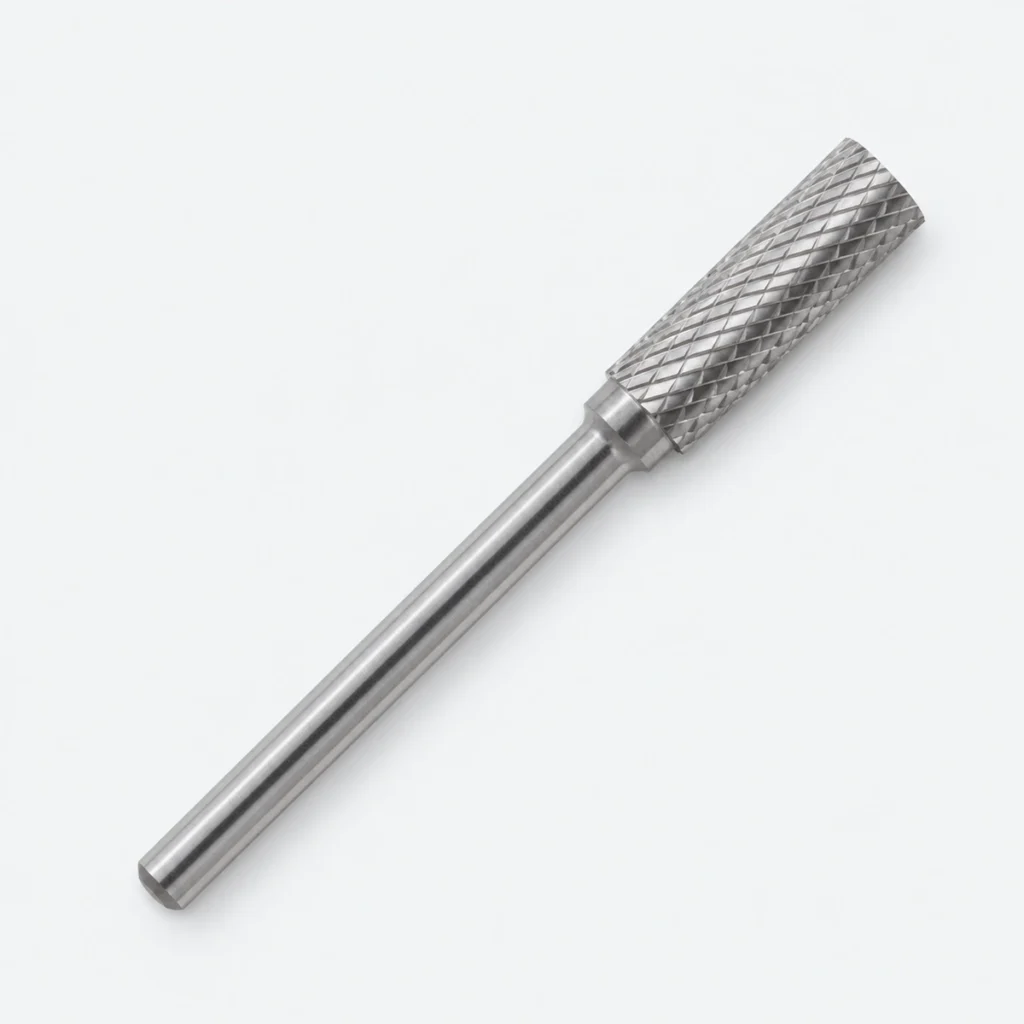
On the Nexus ToolPal CB-01 drawing, D1 spans the cutting head and D2 spans the smooth shank that the collet grips. L1 runs along the cutting head, and L2 runs the full length of the burr. All four dimensions use millimetres. CB-01 SA cylinder carbide burr size chart CB-01 dimension drawing
Compare two 5 mm heads with different shanks
Read the item number under Double Cut, then follow that row across all four dimensions. Comparing carbide burr shank sizes down the D2 column explains why “5 mm cylinder, double cut” leaves the order open to two answers.
| Item | Head D1 | Shank D2 | Head length L1 | Overall length L2 |
|---|---|---|---|---|
| SA-53M | 5.0 mm | 3 mm | 12.7 mm | 38 mm |
| SA-14M | 5.0 mm | 6 mm | 16 mm | 50 mm |
The 6 mm shank comes with a head that is 3.3 mm longer and a burr that is 12 mm longer overall. If the buyer needs the 38 mm overall length with a 6 mm shank, ask for a separately documented part. Keep the shank matched to the collet.
Once the shank fits the collet, compare carbide burr shapes by work surface to select the head profile.
Keep the head length and overall length in separate fields. On SA-53M, 12.7 mm is the length of the cutting head, while 38 mm is the length of the complete burr. A line that says only “length 38 mm” leaves room for the seller to read it as a head length.
Catalog conventions also vary by maker. Grier’s SA-3 row gives a 3/8-inch cutting diameter and a 1/4-inch shank. When comparing carbide burr shank sizes across brands, read the column headings and keep each maker’s item code with its own dimensions. Grier SA sizes
Which CB-01 shanks are documented?
The CB-01 chart shows two carbide burr shank sizes in the Double Cut and Plain Cut section, 3 mm and 6 mm, depending on the item. In the Aluma Cut section, all five rows show a 6 mm shank even as the head diameter increases from 6 to 19 mm. CB-01 dimension drawing
If your list of carbide burr shank sizes includes a quarter-inch entry, ask the seller for its part code and drawing. Keep that request open until you receive the imperial specification and a written answer on availability.
What should buyers put on the RFQ and purchase order?
Give the shank its own field on both forms so the shop can check the fit at a glance. For each line, give the series, item number if known, cut, head dimensions, shank diameter, overall length and quantity. Carry carbide burr shank sizes through in the units the supplier will confirm.
Copy a metric order line or request an imperial item
Once the head and shank both match, copy the metric row and add the order quantity. Ask the seller to repeat the item code, both diameters and their units on the order confirmation.
To add quantities, samples and delivery terms, turn the confirmed dimensions into a bulk RFQ.
For an inch shank, ask the seller for its own part number. Send the customer’s drawing or finished dimensions with the request.
When the quote comes back, compare its lines with your request. A response that gives only the head diameter still leaves the shank open. A response that gives the right shank but a different overall length needs a separate decision. Record which line the buyer approved before you issue the order.
Buyer questions about carbide burr shank sizes
These questions come up when a grinder model, a burr drawing and a supplier quote use different labels. Use the part number to connect all three.
Can a 6 mm burr go in a fixed 1/4-inch collet?
Specify the shank the collet maker calls for. A fixed quarter-inch collet calls for a quarter-inch shank. If a supplier proposes a range, ask for the maker’s specification for that exact collet.
Which dimension on CB-01 should I use to filter carbide burr shank sizes?
Filter on D2 first, then check D1 for the required head diameter. Read the cut and both lengths before copying the item number.
What if a quote lists the shank as “6 mm / 1/4 inch”?
Ask which size the seller will ship and request a drawing in the original unit. If you need both sizes, ask for separate quote lines with an item number and quantity on each.
When you reorder, check carbide burr shank sizes against the installed collet and the supplier’s item number. For CB-01, send the complete D2 row with the quantity. To compare other head profiles, browse the carbide burr catalog.