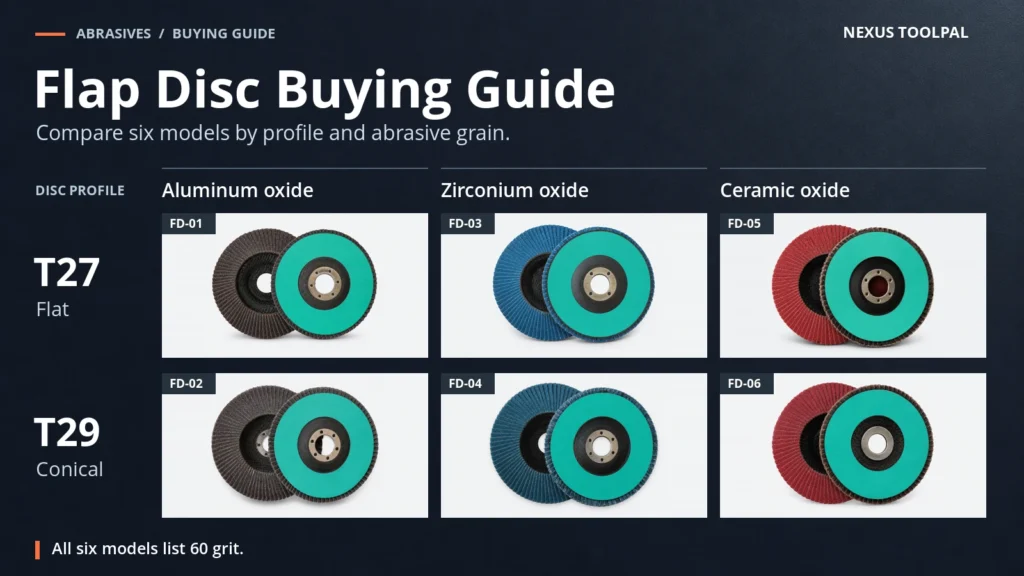
A buyer asks for a box of 60-grit flap discs. All six models below come in that grit. Which one did the shop mean?
Here’s how to choose flap discs for an order. Match the shape to the part, pick a grain and grit, then check the grinder.
Ask for a photo of both the job and the label on the last box. One shows where the disc needs to reach. The other identifies the starting point.
Use this guide when the buyer has named a flap disc. If the type of accessory is still open, start with the power tool accessories buying guide.
How to choose flap discs by grain and grit · Check grinder fit · Copy the quote request
T27 flat vs. T29 conical flap discs: Which shape fits the job?
T27 is a flat profile suited to blending a broad face. T29 has a conical profile that concentrates contact and can help remove excess weld metal.
A steel bracket can need both jobs. Ask the buyer to mark the raised weld, the face to blend and the corner that must keep its shape.
What finish will the next shop accept?
Ask for an accepted part, a drawing note or a finish sample. “Blend the weld to this sample and keep the corner” gives two sellers the same target.
Ask what happens after the weld passes inspection. If a paint shop takes over, find out which sander, pad and attachment it uses.
A sanding disc for that pad may be the next item on the order. Browse the power tool accessories catalog to find the right family.
How does the shape affect contact?
For a flat-face blend, start with T27. If the shop needs to take down a raised weld, consider T29 and check that the tool can reach it.
A flat profile describes the disc shape. Use the working face and angle that the maker specifies for the exact disc. See Norton’s flap disc profile guide.
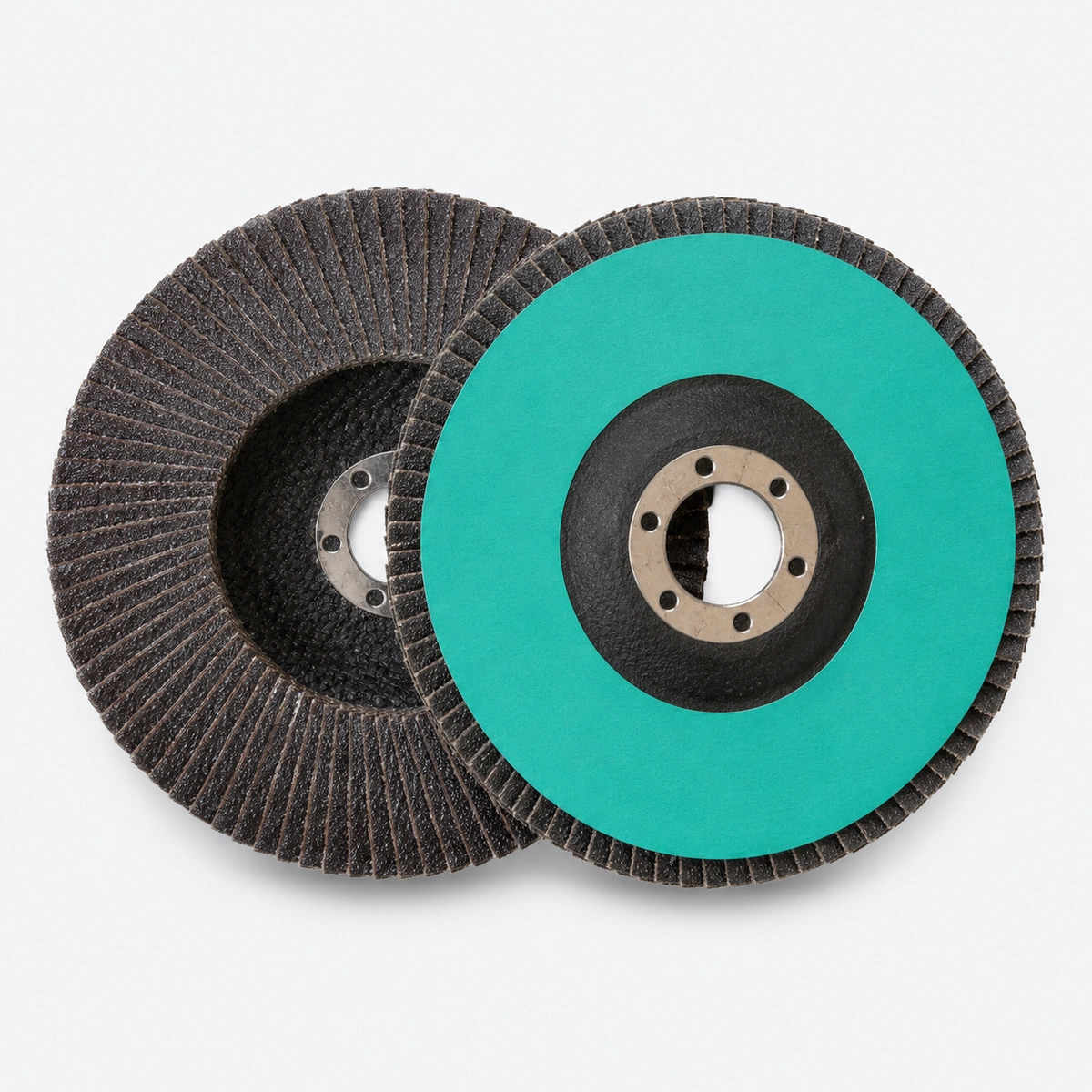
Compare FD-01 flat with FD-02 conical at 60 grit. Both use aluminum oxide, so this pair lets the buyer try a change of profile.
How to choose flap discs by grain and grit
Grain names the abrasive material. Grit describes its size grade. Use the table to find a listed combination before you ask for a price.
| Model and product record | Profile | Catalog abrasive and code | Listed grits |
|---|---|---|---|
| FD-01 | T27 flat · QFF | Aluminum oxide (A) | 40 / 60 / 80 / 120 |
| FD-02 | T29 conical · QFC | Aluminum oxide (A) | 40 / 60 / 80 / 120 |
| FD-03 | T27 flat · QFF | Zirconium oxide (Z) | 40 / 60 / 80 / 120 |
| FD-04 | T29 conical · QFC | Zirconium oxide (Z) | 40 / 60 / 80 / 120 |
| FD-05 | T27 flat · QFF | Ceramic oxide (Co) | 40 / 60 |
| FD-06 | T29 conical · QFC | Ceramic oxide (Co) | 40 / 60 |
See the TECHSHIELD flap disc catalog for QFF and QFC profiles, grain codes and grits on pages 19–21. The linked product records identify each Nexus SKU.
Follow each model link for its catalog entry. “Co” is the supplier’s code for ceramic oxide. Find the full family in the flap discs catalog.
All six models list 40 and 60 grit. Only FD-01 through FD-04 also list 80 and 120. That gives 20 model–grit pairs across the six records.
A box marked “QFF, 60 grit” still matches three T27 flat models. “QFC, 60 grit” leaves the same choice among three T29 conical models. Ask for the grain code.
Treat these as catalog options. Ask the supplier for the available size, stock and lead time for the exact item you want to buy.
Which grain should the shop trial?
Start with the disc the customer already accepts. Ask what they want to improve: the finish, the time per part or the disc cost per good part.
For a T27 trial at 60 grit, FD-01, FD-03 and FD-05 offer three grains. Keep the approved disc as the reference.
Give the supplier the metal grade and finish target. Ask which of the three they would sample and what change the shop should look for.
For example, the 3M flap disc selection chart lists its Ceramic Pro line for stainless steel and high-tensile alloys.
For FD-05 or FD-06, ask Nexus ToolPal to confirm the proposed grade and material pairing. Check the result on the buyer’s own part.
Keep an accepted part at the inspection bench. Have the same person compare it with each trial piece and record any work needed before paint.
When does a finer grit change the shortlist?
Within this range, higher numbers mean finer grit. If the next process rejects the scratches left by 60 grit, test a finer grade against the finish sample.
For an 80-grit T27 disc, the table lists FD-01 and FD-03. If the last box was FD-05 ceramic, either choice changes the grain too.
Write both changes on the quote. If the buyer needs to keep the ceramic grain, ask for a documented 80-grit option and its label.
Flap disc size, mount and speed: Will it fit the grinder?
Match the grinder manual to the label or drawing for the exact disc on offer. The same model family can leave several fit details open.
| Item and documented choice | Supplier to confirm for that version | Buyer to obtain |
|---|---|---|
| FD-01 · T27 flat, aluminum oxide, grit 60 | Outside diameter, bore or mounting details, thickness and marked maximum speed | Grinder model, maker’s size and mount limits, guard and maximum tool speed |
| FD-02 · T29 conical, aluminum oxide, grit 60 | Outside diameter, bore, angle specification and maximum speed for the quoted variant | Same machine checks, including approval for the intended profile and task |
Which speed and mounting details matter?
Read the maximum speed on the grinder. The maximum RPM marked on the disc must equal or exceed that speed. See Norton’s flap disc safety guide.
Check the approved accessory type, outside diameter, mount and guard for the intended task in the grinder manual. Follow the Power Tool Institute accessory guidance.
Copy any bore size or thread designation exactly as marked. When the quotation omits a rating or dimension, get the variant sheet before approving the line.
What do the FD-01 and FD-02 records leave open?
The FD-01 record calls for checks on diameter, bore, thickness and maximum speed. FD-02 also calls for the angle of the quoted version.
If a drawing covers several sizes, ask the supplier to circle the row they priced. Keep that page and the label with the quote.
At goods receipt, compare the delivered model, size, grit and speed marking with that record. Resolve a mismatch before sending the box to the shop.
How to choose flap discs for a 60-grit distributor trial
Suppose a metal shop wants to compare shape and grain before a bulk order. One reference model and two alternatives can answer those questions.
Why request 40, 20 and 20 discs?
In this example, use FD-01 in both comparisons. FD-02 changes the shape. FD-03 changes the grain. All three lines call for 60 grit.
| Requested line | Quantity (discs) | Reason for the line |
|---|---|---|
| FD-01 · flat T27 · aluminum oxide · 60 grit | 40 | Reference disc for the flat-face blending job and both comparisons |
| FD-02 · conical T29 · aluminum oxide · 60 grit | 20 | Compare profile while holding grain and grit steady |
| FD-03 · flat T27 · zirconium oxide · 60 grit | 20 | Compare grain while holding profile and grit steady |
| Total across three quote lines | 80 | Replace these example quantities with actual customer demand |
Confirm that all three variants fit the same approved grinder. Ask for the pack count and minimum order for each. Adjust the quantities to suit the shop.
If a seller rounds the trial up to full packs, ask for the new piece count and price for each line.
Use the same part, finish target and inspection method for both comparisons. Record time per accepted part, discs consumed and any rework.
To find abrasive cost per good part, multiply the price per disc by the number used. Divide by the number of parts that passed.
A shop that uses six discs at $2 each to finish 24 accepted parts spends $0.50 per good part on discs. Record labor and rework separately.
How do you compare the two quotes?
Ask both sellers for a price per disc, pack size and delivery terms to the same destination. Divide a box price by the confirmed count for that box.
Keep the sample fee, sample freight and dispatch date separate from the bulk price. Ask how long the quote is valid and what it includes.
Put the requested item and any substitute in separate columns. A change of grain, profile or pack count should be easy for the buyer to spot and approve.
Copy this three-line flap disc quote request
Select Flap Discs under Product Category. Enter the total disc count under Estimated Quantity. Paste the lines below into Requirements.
Replace the example counts and brackets before sending. Include one product link in Reference Product Link and identify the other models in the message.
Please quote each line separately at 60 grit.
1. FD-01 · T27 flat · aluminum oxide · 40 discs.
2. FD-02 · T29 conical · aluminum oxide · 20 discs.
3. FD-03 · T27 flat · zirconium oxide · 20 discs.
Workpiece, task and finish sample: [details]. Grinder make, model and manual page: [details].
For each variant, attach the label or drawing. State outside diameter, bore or threaded mount, applicable thickness, maximum RPM and working-angle instructions.
Quote [currency] per disc to [city, country, postal code]. State freight, delivery terms, start date for lead time and quote validity.
List pieces per pack, minimum order, sample terms, available quantity and dispatch time. Put proposed substitutes on a separate line for approval.
Flap disc ordering FAQ
Check these points when a grade is missing or a buyer wants the same box again.
Do FD-05 and FD-06 come in 80 grit?
Their catalog entries list 40 and 60 grit. For an 80-grit ceramic disc, request a separate model reference and its label.
Which models list 80 grit if the buyer can change grain?
For a flat T27, check FD-01 or FD-03. For a conical T29, check FD-02 or FD-04. Have the buyer approve the new grain.
What should accompany a repeat 60-grit order?
Copy the approved SKU, profile, grain, grit, size, mount and rated speed. Attach the matching label. Recheck fit if the shop changed grinders.