Here’s how to choose power tool accessories for a distributor range. Start with the surface, the finish the customer needs and the machine they own.
Suppose two customers ask for “discs for metal.” One needs to blend a weld on a steel frame. The other wants refills for a paint-shop sander.
Both may ask for the same grit. The first buyer needs a disc that can reach the weld. The second needs a disc that fits the backing pad.
How to choose power tool accessories by job ↓ · Use the sample quote request
What work will your customers buy the accessory to do?
Ask the customer to point to the area they want to change on the workpiece. Record what the next process needs from that surface.
“Steel frame, outside weld, ready for paint” gives purchasing three things to check. An enquiry that says “metal” still leaves all three open.
Turn a vague enquiry into a workpiece description
Ask for one wide photo to show the space around the job. On a close view, have the customer circle the area the accessory must touch.
On a casting, the circle may mark a raised burr near an edge that must stay sharp. On a frame, it may mark an exposed weld.
Record the material grade if known. Ask for the finish sample or inspection point used to sign off the work.
A photo helps you locate the edge. Ask for dimensions to check the clearance behind it and the amount of stock the customer wants to remove.
One question often settles the choice: “What happens to this part next?” A painter may want an even scratch pattern on body filler.
A maintenance buyer may just need to remove one sharp burr. Keep that answer with the item so the next salesperson can explain the choice.
Record the machine the customer already owns
Ask for the make, exact tool model and manual page for the planned work. For a burr, ask for the collet marking.
For a sander, get the pad reference and a face-on photo. For a grinder disc, request the mount and guard details for that operation.
Read which accessories the tool maker permits. Match the size, mount and speed rating of the proposed item against that exact model’s instructions.
Keep the manual page with the quote. It gives the next buyer a way to check a substitute. See the Power Tool Institute accessory guidance.
How to choose power tool accessories by job: four families
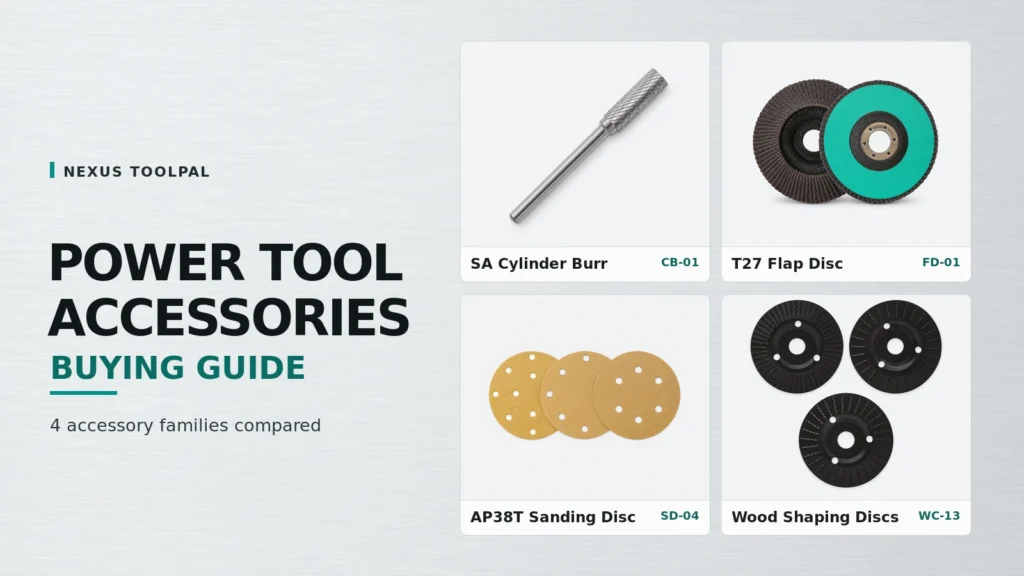
The Nexus ToolPal power tool accessories catalog lists four families. Use the surface in the first column to find a candidate and the question to ask next.
| Customer job | Candidate family | Catalog example | Question before quoting |
|---|---|---|---|
| Remove a burr on a straight inside wall | Carbide burrs | CB-01 · SA-14M | Which head fits the feature and which shank fits the collet? |
| Blend an exposed weld on metal | Flap discs | FD-01 · T27 flat | Which profile, grit and mount does the job require? |
| Prepare a surface for paint | Sanding discs | AP38T or SG650 | Which diameter, attachment and hole layout match the pad? |
| Shape a contour in wood | Wood carving and shaping discs | WC-13 · marked photo | Which version does the customer want, and does the tool maker permit it? |
Catalog snapshot, November 23, 2026. The four linked categories showed 13 burr, six flap disc, six sanding disc and 14 wood disc listings. These add up to the parent catalog’s 39 listings. A listing can cover several sizes or photo references.
Carbide burrs for a local feature
For a straight wall inside a recess, start with a cylinder head. Ask which face must cut and how wide the opening is.
If the job also includes the floor or a rounded corner, mark that second surface on the drawing. Then compare 13 carbide burr profiles.
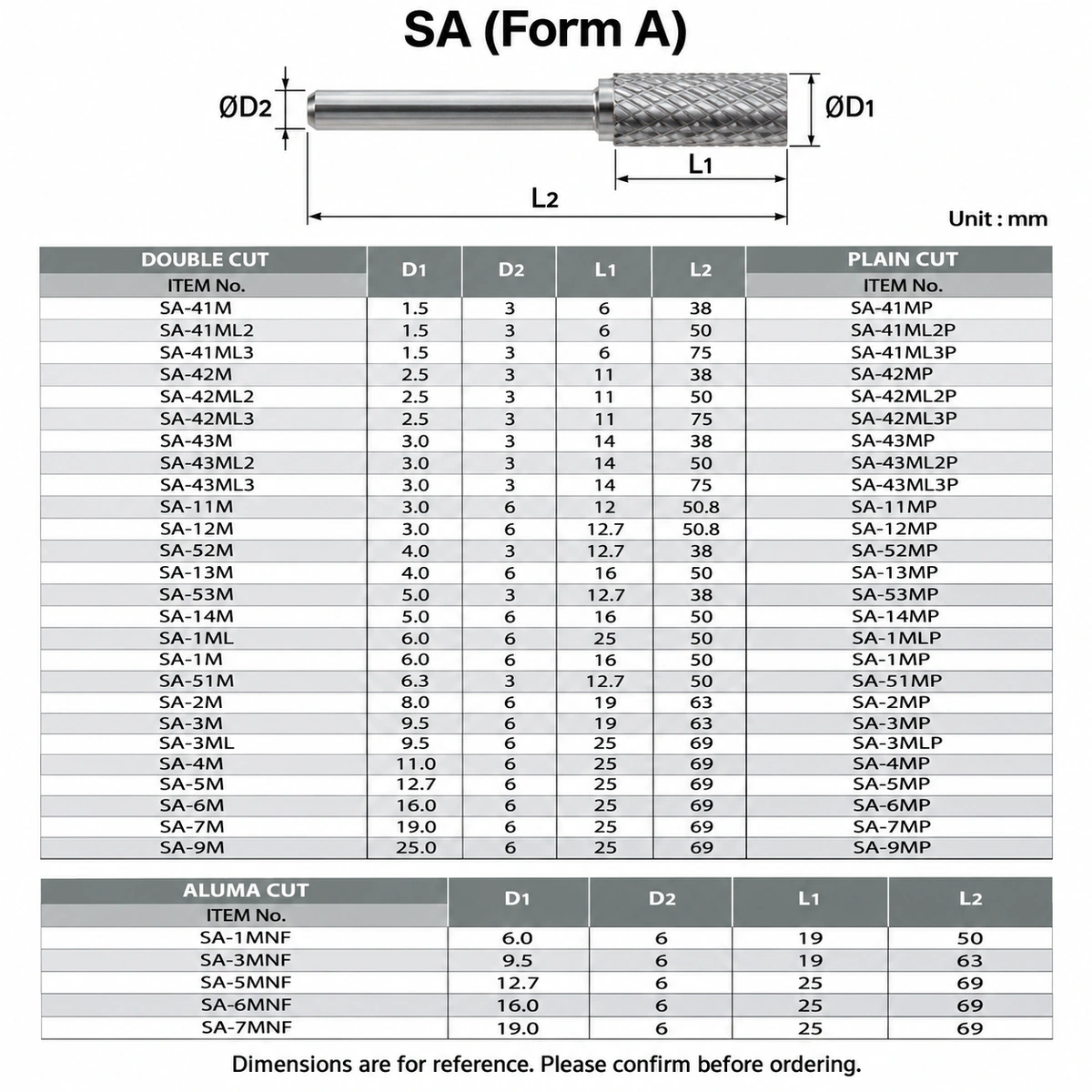
The CB-01 product page identifies the SA cylinder family. Its metric item chart lists SA-14M under Double Cut.
SA-14M has a 5 mm head, a 6 mm shank, a 16 mm head length and a 50 mm overall length.
If a customer calls this a “5 mm burr,” ask where they measured it. That number describes the head here. The collet must match the shank.
Keep the item code and all four dimensions on the request. Sales can price the right row, and receiving staff can see which end to measure.
Flap discs for accessible metal surfaces
Consider a flat flap disc for an exposed weld on a flat steel face. Record both the profile and abrasive grain when asking for a substitute.
The flap disc catalog lists three grain options for each profile. Check the profile first if the customer needs the same contact with the workpiece.
| Profile | Grains available as separate listings |
|---|---|
| T27 flat | Aluminum oxide · zirconium oxide · ceramic oxide |
| T29 conical | Aluminum oxide · zirconium oxide · ceramic oxide |
FD-01 is a flat T27 disc with aluminum oxide grain. The listed grits are 40, 60, 80 and 120.
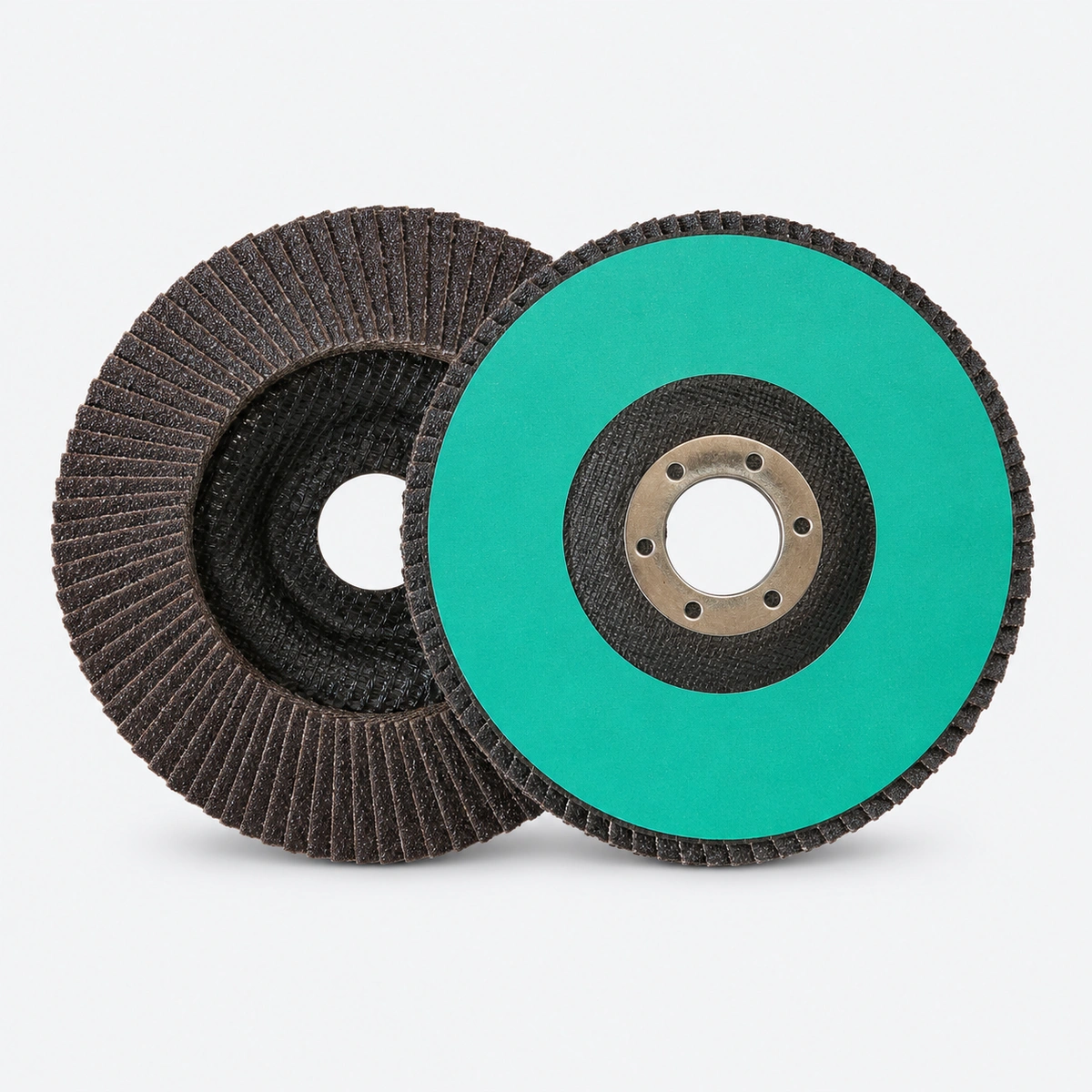
If the buyer wants grit 60, write it on the enquiry. Ask for the exact variant’s outside diameter, bore, thickness and maximum operating speed.
Ask for the speed marking on the disc. Its rated maximum must meet or exceed the grinder’s maximum speed.
Check size, mounting hardware and the specified guard in the tool manual. See Norton’s flap disc guidance.
Sanding discs for a specified finish and backing pad
For a finishing sander, start with the pad and the finish the customer needs. Two discs can have flocked backs yet use different bases and grains.
| Model and source | Base | Abrasive grain | Back |
|---|---|---|---|
| AP38T · SD-04 | Reinforced fiber latex paper | Aluminum oxide | Flocked |
| SG650 · SD-05 | Polyester film | Zirconia alumina | Flocked |

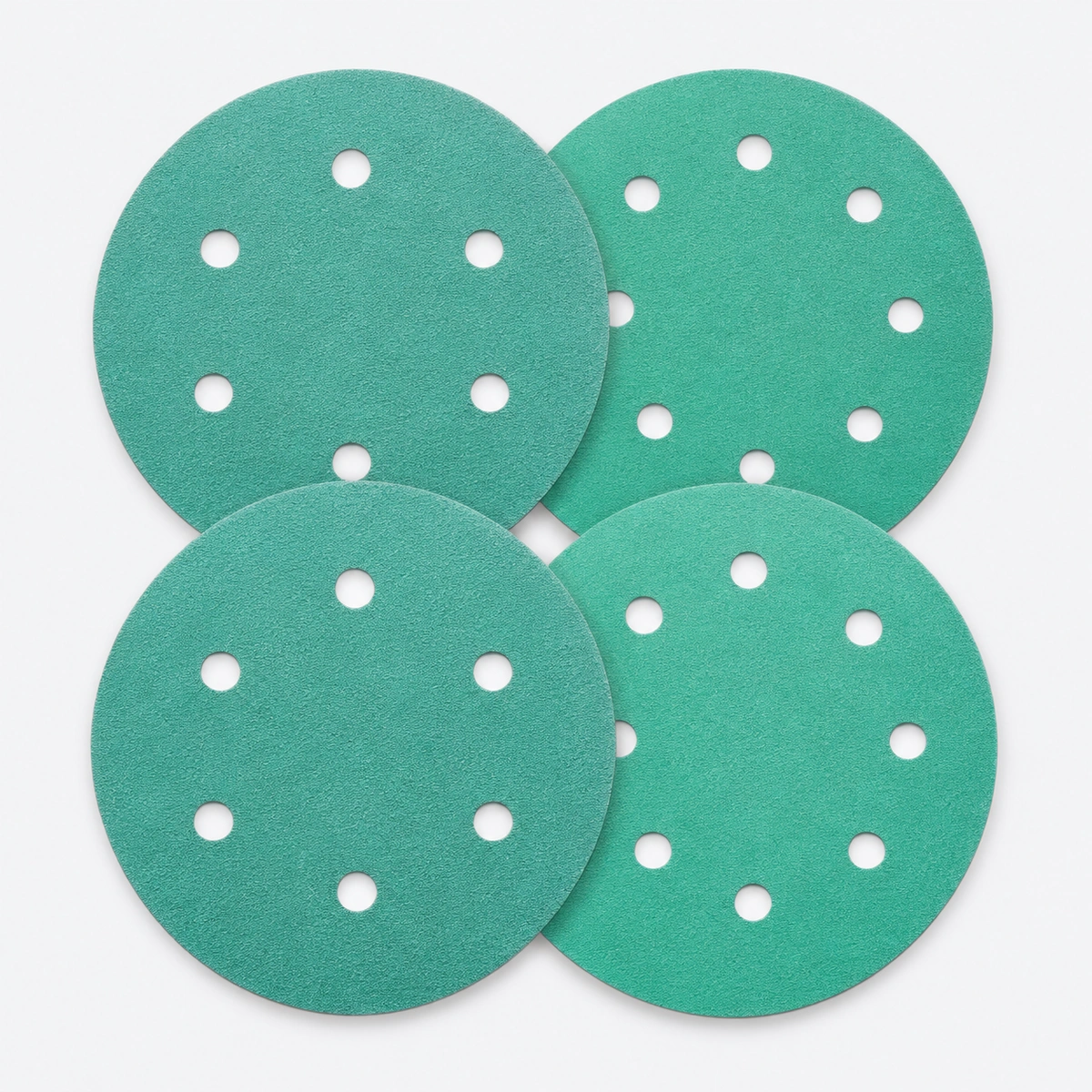
For either model, confirm the ordered grit, disc diameter, attachment and extraction-hole pattern. Ask for the exact pad reference that goes with the sander.
For example, Mirka’s pad page names the six-inch Galaxy Multifit discs it supports. Ask for that level of detail for the combination you plan to sell.
If the customer asks which lasts longer on body filler, agree on a sample trial with the same grit, pad, surface and finish target.
Agree when to change the disc. Both the base and grain differ here, so this trial compares the two complete products.
Wood shaping discs for a defined contour and machine
On the WC-13 product page, A, B and C identify photos of three black beveled discs. Ask the buyer to circle the version they mean.
The page lists a 125 mm outside diameter and a 22 mm bore for each. B shows closer tooth spacing. Request the variant code, drawing and speed marking.
Keep the purpose of the three small holes open until the drawing identifies them. The bore and outside diameter alone cannot establish an approved use.
The UK OPSS alert on toothed saw blades advises users to stop using these attachments on angle grinders and businesses to remove affected products from sale.
For WC-13, obtain the tool maker’s instructions for the exact machine, attachment and task. Hold the line for review if that evidence is missing. Tool manufacturer checks.
Which specifications identify an orderable accessory?
Give each measurement a name and unit before entering it in stock records. The checklist separates fields you can copy from the catalog from those you must confirm.
| Family | Copy from the item record | Evidence still needed for the job |
|---|---|---|
| Carbide burr | Family, item, cut, head Ø D1, shank Ø D2, head length L1 and overall length L2 | Customer’s collet marking and supplier’s matching dimension row with units |
| Flap disc | Item code, profile, abrasive and grit | Variant diameter, mount or bore, thickness, speed marking and tool manual |
| Sanding disc | Model, backing material, abrasive and back treatment | Pad model, disc diameter, attachment, requested grit and hole layout |
| Wood shaping disc | Picture reference, profile, outside diameter and bore | Variant drawing, speed marking and tool maker’s approved machine and mount |
Source pages for the checklist · SA cylinder, FD-01 flap disc, AP38T, SG650 and WC-13. Use the matching machine manual alongside the product record.
Shank, bore and dust holes answer different questions
The burr shank fits the collet. A disc’s center mount mates with the machine’s mounting system. Dust holes follow the extraction layout on the sanding pad.
For WC-13, a “125 mm” entry tells you the outside diameter. Give the bore its own field so the next buyer can check both dimensions.
Record the units exactly as marked on the tool. A 1/4-inch collet and a 6 mm shank have different nominal sizes.
Ask the supplier for the matching shank and have the buyer verify the collet marking. Check the burr shank against the collet.
For a sander, compare the pad part number and a face-on photo with the drawing for the proposed disc.
“Eight holes” gives you a count. You still need their spacing. File the drawing with the quoted variant so receiving staff can repeat the check.
Which missing fields should hold a line for confirmation?
Make two columns on the buying sheet: “documented” and “to confirm.” For FD-01, record T27, aluminum oxide and the requested 60 grit.
Under “to confirm,” name who owns each answer. The supplier provides variant dimensions and ratings. The customer identifies the grinder and its permitted accessories.
Once you establish fit, a sample can help check the finish, label and pack. Record the approver, sample ID, approval date and drawing or label revision.
Reopen the fit check if the supplier proposes a different mount or a different pictured version on the next order.
How do you build a distributor shortlist and request a quote?
To select power tool accessories for resale, start with jobs buyers already ask about. Keep a machine model beside each line where you have one.
Give every candidate a next step. Ask for a price when the variant is clear. Ask for a drawing when an open dimension could change the order.
Which items belong in the first trial?
In this example, a metal shop has two jobs: clean a straight recess and blend an exposed weld. Both go on the trial sheet.
The SA-14M catalog row is clear enough to request pricing. For FD-01, request the missing variant details and hold approval until the grinder check is complete.
Use enquiry dates, repeat sales and the number of shops with the same equipment to plan your trial. Also check when the next order is likely.
Check whether one inner pack fits that demand. The quantities below illustrate the enquiry. Replace both quantities and pack requests with your own before sending it.
| Item and documented specification | Trial quantity and pack | Requested reply and open fields |
|---|---|---|
| CB-01 / SA-14M · Double Cut · D1/D2/L1/L2 = 5/6/16/50 mm | 100 individual burrs, one per tube | Quote per piece. State MOQ, sample terms, freight basis and lead time to the destination below. |
| FD-01 · T27 flat, aluminum oxide, 60 grit | 50 individual discs. Please propose an inner pack. | Return diameter, bore, thickness and speed marking for the actual variant. Match to customer’s grinder before price approval. |
What should go into the shortlist enquiry?
Send one item per line, its job and a named destination. Ask for the trial unit price, sample cost and freight on separate lines.
If the buyer wants its own label, ask about the artwork fee and whether the charge recurs on an unchanged repeat order.
Copyable mixed-accessory quote request · replace the brackets and example counts
The example below asks the supplier to price one burr and check one disc. Replace the example counts, equipment details and destination.
Workpiece and grade: [enter]. For the straight wall, quote 100 CB-01 / SA-14M burrs, Double Cut, packed one per tube.
Head 5 mm, shank 6 mm, head length 16 mm, overall length 50 mm. Tool and collet: [model and marking].
For the exposed weld, review 50 FD-01 discs for [grinder model]. Flat T27, aluminum oxide, 60 grit. Please propose an inner pack.
Attach the disc dimensions, mounting details and speed marking. Flag any fit questions and list each substitute under its own item code.
Quote each item in [currency] per piece to [city, country and postal code]. State the delivery term, minimum order, sample cost and freight basis.
List lead time, quote validity and any one-time packing or artwork fees.
On the quote form, fill in Estimated Quantity. In Requirements, give separate lines for the 100 burrs and the 50 discs so the units stay clear.
Send your accessory shortlist for a quote
For an order of burrs alone, use the bulk carbide burr quote template. It shows how to check a supplier’s reply against the catalog row.
On a mixed order, keep each open question beside the item until you have a written answer. Save it with the quote for the next reorder.
Buyer FAQ · How to choose power tool accessories for a specific machine
Use these three questions at the trade counter or when you check a supplier’s reply.
What should I ask when a customer first requests an accessory?
Ask which surface needs work, what finish they want and which tool model they own. Use the manual to check the proposed accessory before you quote.
Does a flocked back tell me which sanding disc fits my pad?
It identifies a back treatment. Confirm the actual attachment, diameter and hole layout for the exact pad and disc you plan to order.
Can I send a shortlist with an unfinished specification?
Yes. Mark the missing fields and who will confirm them. Request prices for identified variants and drawings or ratings for items that still need a fit check.