
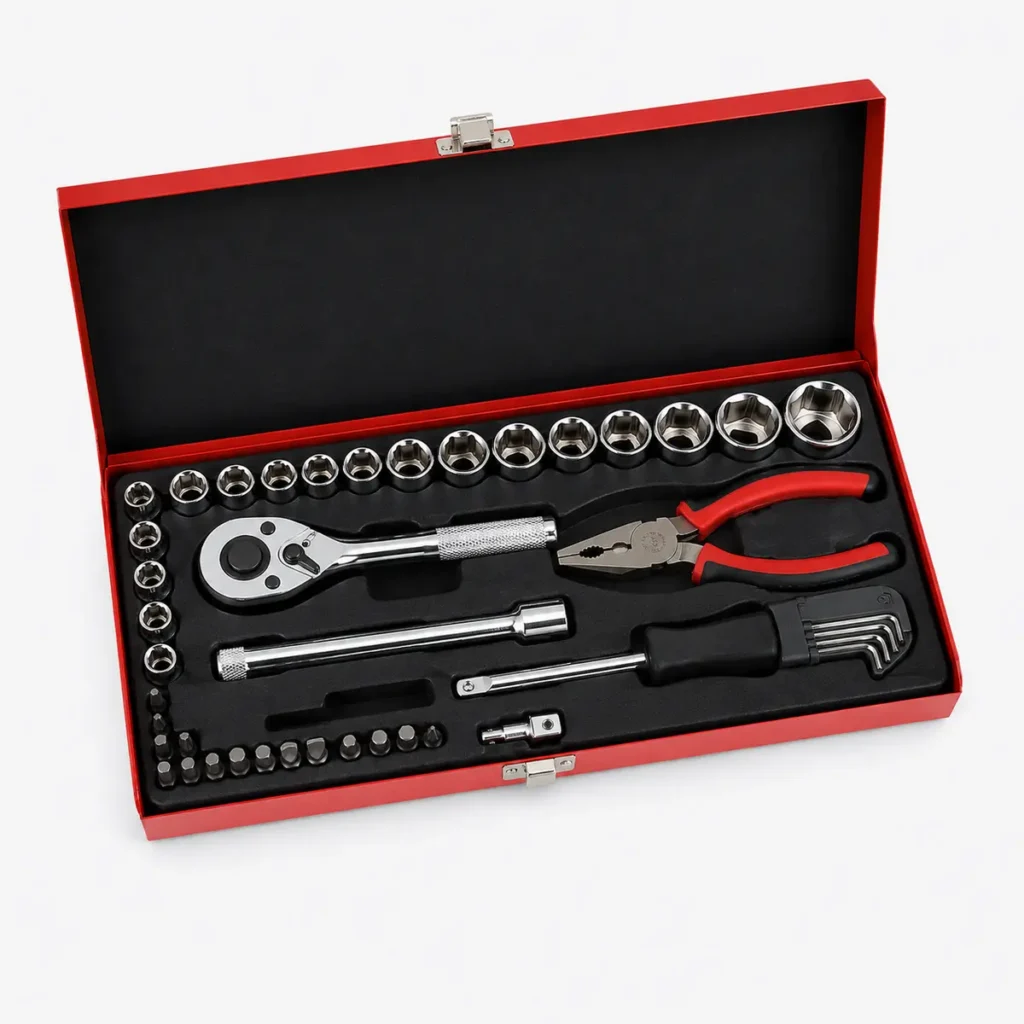
A good tool set covers the tasks and sizes its owner actually needs, keeps those tools organized, and offers dependable quality and replacement support. The largest number on the box is only a count. It does not tell you whether an essential size is missing or whether the case will keep its contents secure.
This guide focuses on hand tool assortments for home maintenance, mechanics and professional purchasing. It explains how to compare contents, read specifications and assess value. Importers and private-label brands will also find a practical framework for turning a broad product idea into an agreed supplier specification.
What Is a Tool Set?
A tool set is a group of tools or accessories sold as one assortment. Some sets combine different hand tool categories; others concentrate on sockets, wrenches or screwdrivers. “Tool kit” is often used similarly, so the contents list matters more than the name.
A socket set is a focused subset of the category, while a mechanics tool set may add wrenches, hex keys and other accessories. A power tool combo kit is a different product category with motor, battery and charger considerations. The comparisons below concern manual hand tools.
Which Type of Tool Set Fits the Intended Use?
| Set type | Main purpose | What to examine first |
|---|---|---|
| Home tool set | A mixed assortment for routine household maintenance | Useful variety, manageable storage and clear identification. |
| Mechanics tool set | An assortment centered on fasteners and mechanical equipment | Exact socket and wrench coverage, measurement system and drive sizes. |
| Socket tool set | A focused collection of sockets and related hand-drive tools | Size list, socket depth, profiles and compatible drive components. |
| Portable maintenance kit | A compact assortment that is regularly transported | Required coverage, loaded weight and retention in the case. |
| Workshop or modular set | An organized system intended to expand over time | Tray dimensions, inventory visibility and replacement availability. |
A specialist collection can be excellent within its scope while unsuitable for a general household assortment. Define the intended user before comparing brands or prices. For a distributor, that means choosing a customer segment before deciding how many pieces the retail box should advertise.
1. Compare Useful Coverage Before Piece Count
The key question is: which required sizes and functions does this assortment cover? Separate the contents into actual tools, sockets, bits, adapters and storage components. Confirm how each supplier calculates its advertised count.
For example, STANLEY’s 201-piece mechanics set lists several component categories, including ratchets, sockets, hex keys and combination wrenches. The lesson is to read the breakdown rather than interpret “201 pieces” as 201 equivalent working tools. This is a catalog example, not a comparative product test.
Use a coverage matrix: put every required size or function in a row and each candidate set in a column. Mark an item as confirmed, missing or unverified. A missing mandatory item should block approval until it is resolved; a low price should not cancel that requirement.
| Illustrative comparison | Set A | Set B |
|---|---|---|
| Advertised piece count | 150 | 90 |
| Required coverage | One mandatory size missing | All mandatory sizes listed |
| Extra contents | Many accessories outside the defined need | Fewer extras |
| Decision | Resolve the gap before comparing value | Proceed to quality and cost review |
This example uses invented assortments to demonstrate the method. It is not market data or a claim that smaller sets are always better. Larger sets make sense when their additional coverage has a defined purpose.
2. Check Metric, SAE and Drive Sizes Separately
Metric and SAE describe the fastener-size system. Socket drive size describes the connection between the socket and its driving tool. They are different specifications: a 3/8-inch drive socket can have a metric fastener opening.
Choose coverage from the equipment and customer requirements, rather than from the destination country alone. Some customers need metric only; others maintain a mixed fleet and need both systems. Our metric versus SAE socket set guide explains the distinction in more detail.
A range is not a complete list. An 8–19 mm description identifies the endpoints, but does not necessarily promise every size between them. Likewise, shallow and deep sockets are separate coverage lines. Ask for the exact sizes within each drive, depth and profile group.
TEKTON describes its assortments as organized systems assembled from individual components, with an emphasis on avoiding skipped sizes. That is a useful example of explicit coverage positioning. For any specific set, verify the individual contents rather than transfer a general brand statement to every configuration.
3. Treat Material Names as the Start of Quality Review
“Chrome vanadium” and a polished finish do not, by themselves, define the quality of a complete tool set. Different components may have different material and treatment requirements. Ask which material claim applies to which component, and what evidence supports it.
A useful quality specification connects a requirement to a verification method and an acceptance limit. “Good quality” is not an inspection instruction. Neither is a broad statement that the entire assortment meets unspecified international standards.
| Requirement area | Evidence to establish before approval |
|---|---|
| Contents and dimensions | An itemized bill of materials and relevant dimensional tolerances. |
| Functional performance | Applicable test methods, sample identification and acceptance criteria. |
| Material and treatment claims | Records tied to the relevant components or production batch. |
| Finish and markings | Agreed appearance limits, readable sizes and a reference sample. |
| Storage and packaging | Retention, closure and transport requirements for the actual packed assortment. |
Do not treat an attractive sample as proof that every production shipment will match it. Document the approved configuration, agree inspection coverage and retain traceability. The hand tool quality-control checklist can help structure that discussion.
4. Include Storage and Replacement Support in the Decision
A case is part of the product experience. Check whether tools remain in their intended positions during ordinary transport, whether markings are visible, and whether frequently removed pieces are easy to identify and return. Confirm the loaded dimensions and weight, not just the empty-case specification.
For a workshop assortment, tray fit and inventory visibility can matter more than a carrying handle. Foam layouts make empty positions easier to see, but a fixed layout may be less flexible when the assortment changes. Modular storage can support expansion, provided dimensions and availability are documented.
Replacement support also affects useful life. Ask whether a missing individual component can be replenished, how it is identified, and what the replacement process involves. A warranty and an individual spare-parts program are separate things; neither should be assumed from the other.
Current Tool Set Themes: Coverage, Compact Kits and Organization
Current manufacturer catalogs show several useful directions for understanding the category. TEKTON’s catalog includes compact kits, metric-only and inch-only selections, and tool sets in foam. GEARWRENCH’s product categories distinguish mechanics sets, master sets and modular foam-organized systems.
These examples support three content themes: defined size coverage, portability, and organized systems that can develop over time. They do not establish which format has the highest sales growth or prove that one format is best for everyone. For purchasing decisions, translate each feature into a specific customer benefit before paying for it.
5. Compare Total Cost on the Same Basis
Price per piece is a weak comparison when two sets contain different mixes of components. A more useful comparison starts with equivalent required coverage, then considers the complete cost of receiving and supporting the assortment.
For an importer, compare: the quoted set price, agreed packaging, freight and handling, applicable import costs, inspection costs and a clearly stated allowance for replacements or claims. Keep assumptions visible and avoid counting a cost twice when it is already included in the supplier’s quotation.
A more compact case may reduce shipping volume, but verify packed-carton measurements before claiming savings. A lower quote may omit retail packaging or a required size. A premium finish may add cost without improving the buyer’s priority outcome. The landed-cost guide provides a framework for comparing quotation scope.
A Professional Decision Framework: Requirements First, Scores Second
Start with mandatory requirements: required contents, accepted specifications, evidence and delivery constraints. A candidate that fails one of these remains unresolved, regardless of its aggregate score. Then compare the candidates that pass using a transparent scorecard.
| Suggested comparison factor | Example weight | Evidence to review |
|---|---|---|
| Useful coverage | 30% | Confirmed size and function matrix. |
| Quality evidence | 25% | Accepted specifications, samples and relevant records. |
| Storage and usability | 15% | Case or tray evaluation for the intended setting. |
| Replacement and service support | 15% | Documented availability and claim process. |
| Comparable total cost | 15% | Quotation scope and stated logistics assumptions. |
These weights are an illustrative purchasing framework, not an industry standard or a measured ranking. Adjust them to the intended customer. Score each factor from 1 to 5 using agreed definitions, and record the evidence behind every score. Missing information should remain unverified rather than receive an optimistic average.
For a first private-label assortment, this process can lead to a focused set with a clear purpose. Add a larger variant only when customer evidence shows which extra coverage matters. Expanding piece count without that evidence increases purchasing, storage and support complexity.
6. Define the OEM or ODM Tool Set Before Approving Artwork
For an OEM or private-label project, settle the assortment and acceptance requirements before logo placement. For an ODM proposal, distinguish an existing supplier design from changes that require development, tooling or renewed verification. Confirm feasibility for the specific proposal.
| RFQ field | Information to provide |
|---|---|
| User and positioning | Intended customer, application scope and price positioning. |
| Contents | Exact tools, sizes, quantities, drive groups and permitted substitutions. |
| Quality | Component specifications, sample approval and inspection requirements. |
| Branding and storage | Marking locations, case or tray layout, artwork and languages. |
| Commercial scope | Quantity, packaging, delivery basis, lead time and sample charges. |
| After-sales and changes | Replacement arrangements and written approval of specification changes. |
Freeze the agreed bill of materials and packaging revision. A change to a handle, finish or case can affect fit and presentation even when the advertised piece count stays the same. Use the hand tool RFQ checklist to prepare comparable requests.
Frequently Asked Questions
What is the best tool set?
The best fit is the assortment that satisfies the required coverage and quality level, stays organized and has suitable support at a justified total cost. There is no universal best set across household, mechanics and workshop needs.
Is a 200-piece tool set better than a 100-piece set?
Not automatically. Compare the contents by size and function. Extra pieces add value when they solve a real coverage need; they do not compensate for a missing mandatory item.
Should a tool set include both metric and SAE sizes?
That depends on the equipment and users it serves. Confirm the required measurement systems and the individual sizes. A mixed set can broaden coverage, while a focused set may reduce unused contents.
What is the difference between a tool set and a socket set?
Tool set is the broader term. A socket set centers on sockets and related components; a mixed tool set may also contain other categories. Verify the itemized list because naming conventions vary.
Can a hand tool set be customized for a private label?
Discuss the exact assortment, marking, storage and packaging requirements with the supplier. Minimum quantities, tooling, sample costs and lead times depend on the proposed design and must be confirmed.
Editorial basis: manufacturer catalog references checked September 18, 2026. This is a specification-based selection guide, not a hands-on brand ranking. The comparison example and scorecard are illustrative. Featured image: Nexus ToolPal’s existing 38-piece socket tool set catalog image.
Choose a Tool Set Around the Work It Must Support
The right tool set combines useful coverage, documented quality, practical organization and dependable replacement support. Start with mandatory requirements, compare equivalent assortments and evaluate the full cost before deciding. For an OEM or private-label hand tool set, send Nexus ToolPal your required contents, quantity and packaging preferences so the proposed configuration and availability can be reviewed against your needs.