
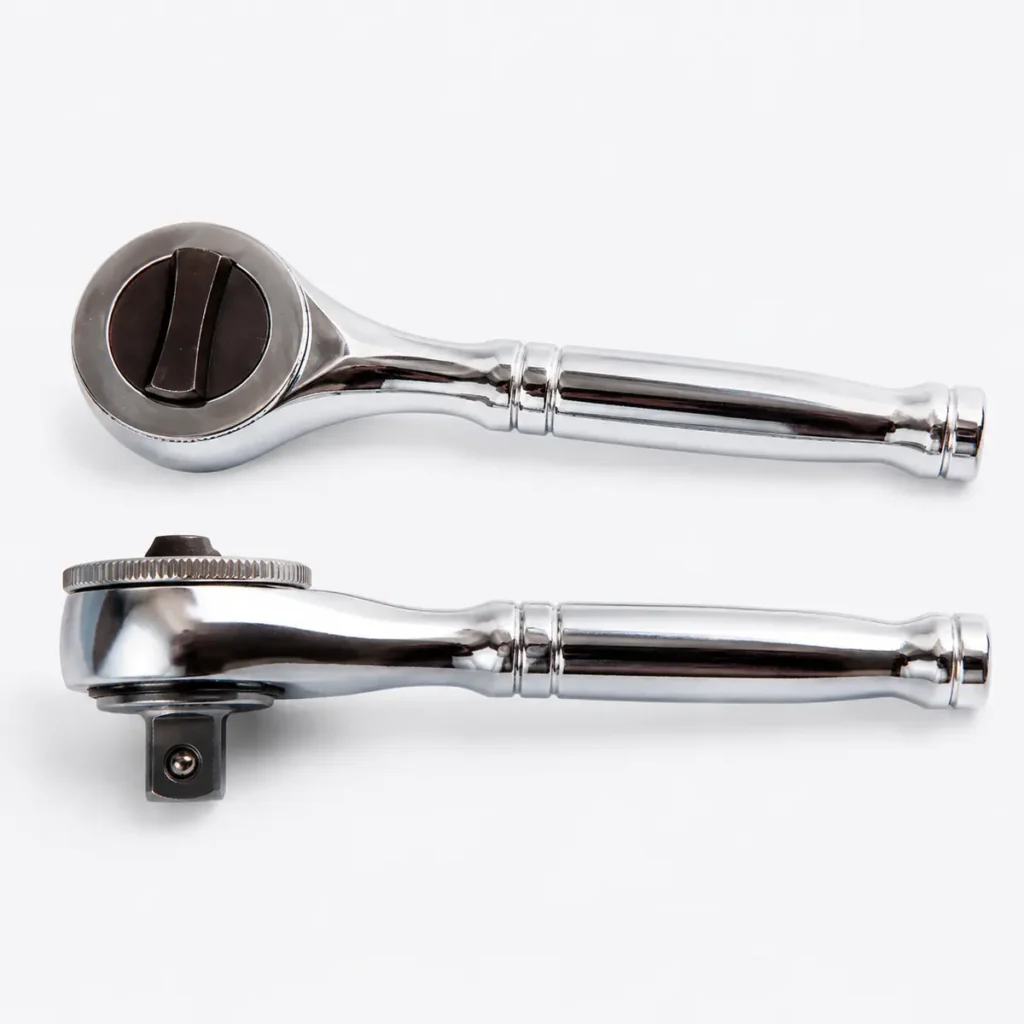
A useful socket ratchet buying guide starts with the work envelope: the socket must seat fully, the head must fit, and the handle and the operator’s hand must move without hitting surrounding parts. For socket-tool buyers and private-label set managers, drive size, handle length and ratchet engagement are separate decisions. A high tooth count cannot compensate for the wrong handle geometry.
Quick answer: Choose a standard handle when the job allows a comfortable grip and needs routine leverage. Choose a stubby handle when the longer handle or the hand holding it hits an obstruction, provided the task remains manageable within the tool’s intended use. A finer ratcheting increment helps when return movement is restricted; it does not establish strength, low return resistance or service life.
This guide covers manual square-drive socket ratchets. For socket depth and the attached assembly, use our 3/8 socket set guide; for assortment coverage, see the tool set configuration guide. Here, the buying decision is which ratchet handle belongs in the kit.
Choose the drive size from the job and the complete assembly
Start with the existing socket interface, the fastening operation and the available space. The drive designation describes the square connection. It does not tell you the fastener opening, the handle length or a universal allowable torque.
- 1/4-inch drive: a practical starting point for compact assemblies and smaller fastening work where control and access matter. Verify the actual socket and head dimensions.
- 3/8-inch drive: a common shortlist for mixed workshop and maintenance sets. Decide separately whether the customer needs a standard handle, a stubby companion or both.
- 1/2-inch drive: consider it when the application and socket range call for a larger drive system. Confirm the selected handle’s permitted use and the complete assembly’s performance evidence.
Treat these as application starting points, not fastener-size or torque limits. An adapter can connect two drive sizes, but it does not upgrade the capacity of the smaller component. A conventional ratchet also does not measure tightening torque; use an appropriate calibrated torque tool when the equipment procedure specifies a tightening value.
Short vs standard handles: compare the same drive first
Nexus ToolPal’s published WT-19 stubby series and WT-06 standard series provide a direct comparison. The figures below are catalog full lengths, not measured hand-grip lever arms.
| Drive / paired item numbers | Stubby full length | Standard full length | Published teeth, both versions |
|---|---|---|---|
| 1/4 in — WT-19-1/4 / WT-06-1/4 | 90.5 mm | 140 mm | 43 |
| 3/8 in — WT-19-3/8 / WT-06-3/8 | 128.5 mm | 200 mm | 41 |
| 1/2 in — WT-19-1/2 / WT-06-1/2 | 153 mm | 249 mm | 45 |
What the comparison establishes: the 3/8-inch stubby is 71.5 mm shorter overall, a calculated reduction of approximately 35.8% relative to the 200 mm version. Both list 41 teeth. The shorter handle changes the space occupied by the tool; it does not add finer ratcheting engagement.
For a compact service kit, that reduction may resolve a handle collision or permit a smaller tool cavity. It is not evidence of a particular carton-volume saving or a 35.8% reduction in leverage. Grip position and drive-center location must be measured separately. These catalog dimensions are reference values; confirm the final drawing and supplied configuration before ordering.
Check what “length” actually measures
Length labels are not always overall dimensions. TEKTON SRH01104 and TEKTON SRH01108 are both fixed, non-quick-release, 3/8-inch-drive ratchets. TEKTON names them by the distance from the drive center to the handle end. Its published specification drawings distinguish that distance from overall length.
| Published dimension | SRH01104 — stubby | SRH01108 — standard |
|---|---|---|
| Drive center to handle end | 4.5 in / 114.3 mm | 8.0 in / 203.2 mm |
| Overall length | 5.1 in / approx. 129.5 mm | 8.6 in / approx. 218.4 mm |
| Head width | 1.2 in / approx. 30.5 mm | 1.2 in / approx. 30.5 mm |
| Head thickness shown in drawing | 0.5 in / 12.7 mm | 0.5 in / 12.7 mm |
Sources: SRH01104 dimensional drawing and SRH01108 dimensional drawing. Millimeter figures are calculated using 25.4 mm per inch; the drawings’ published precision still applies. Both models specify 90 teeth and a 4° swing arc.
Buyer implication: these two handles differ in length while the listed head width and thickness remain the same. If a head cannot pass a nearby obstruction, choosing the stubby version alone will not solve that dimensional problem. For a case insert, request overall length; for leverage evaluation, record the drive center and the actual hand position.
Balance leverage with hand clearance
With force applied perpendicular to the handle, torque equals force multiplied by the distance from the drive center to the force application point: T = F × r. The relevant distance ends at the hand’s effective force position, not automatically at the end of the tool.
Illustrative calculation, not a product rating: producing 20 N·m at an effective grip distance of 100 mm requires 200 N of perpendicular force. At 180 mm, the same calculation requires approximately 111 N. The longer effective lever reduces the required force by about 44%, provided the grip and movement are available. These assumed distances are not measurements of the catalog models above.
This explains why a standard handle is often the better primary choice for repeated work in an open area. A stubby can improve reach around surrounding parts but require more effort at the same torque. Conversely, a long handle that forces the operator to grip close to the head may lose much of its theoretical advantage.
Evaluate the hand as well as the tool. Leave room for the intended glove, a secure grip and a controlled pull. CCOHS wrench guidance recommends initially checking ratchet engagement and applying force steadily; it also advises against pipe extensions and hammering ordinary wrenches. Select the appropriate tool for difficult breakaway work rather than extending a handle to improvise extra leverage.
What tooth count tells you—and what it leaves unknown
The useful purchasing quantity is the specified ratcheting increment: how far the handle must return to reach another engagement position. For a simple mechanism with one effective position per tooth, nominal spacing is 360° divided by tooth count. That arithmetic describes indexing geometry; it is not a strength calculation.
TEKTON’s 90-tooth examples above specify 4°. A different mechanism illustrates why terminology matters: GEARWRENCH’s 120XP technical guide describes two pawls alternately engaging a 60-tooth gear to produce 120 ratcheting positions and a 3° arc. Physical gear teeth and effective positions are therefore not always the same number.
Keep three questions separate when comparing samples:
- Indexing: can the mechanism re-engage within the available handle movement? A stated 4° increment leaves little practical margin if the fixture permits only about 4°.
- Return resistance, often called backdrag: does the return stroke rotate a lightly resisted fastener backward instead of allowing useful progress? Compare this on the same fixture and under the same conditions.
- Lost motion and feel: how much handle movement occurs before the socket starts driving? Assess it separately from the nominal spacing and from return resistance.
Tooth count alone establishes none of the following: proof strength, endurance, resistance to contamination, repairability or low backdrag. Do not assume that finer teeth are inherently stronger or weaker. Ask for evidence covering the actual gear, pawl, head and handle design. A quiet, smooth unloaded demonstration cannot answer a loaded-use question.
Diagnose the obstruction before adding features
| Observed problem | Candidate change | What to verify on the assembled sample |
|---|---|---|
| Handle end or gripping hand hits a nearby part | Shorter handle | A usable grip and sufficient leverage remain; the return stroke clears the obstruction. |
| Head is too wide or thick | Different head geometry or suitable drive system | Head dimensions, socket engagement and clearance; a shorter handle may leave the same head. |
| Handle needs a different approach angle | Flex head, with locking if the task needs it | Joint envelope, angle retention and access to the selector in the working position. |
| Socket is difficult to remove or retain | Quick-release mechanism or a different retention design | Retention with the actual sockets, button access and the resulting head envelope. |
| Little room for the return stroke | Finer effective engagement increment | Useful movement in the fixture, including lost motion and hand clearance. |
Flex, locking, reversing and quick release describe different functions. Specify each independently. A flex joint can change the approach angle, but it is not an automatic substitute for a narrow head or a short handle. A quick-release button can help socket changes, but its position must remain accessible. There is no universal head-size penalty or benefit to assign to either feature without measuring the selected model.
For private-label sets, justify every additional handle
For a general maintenance kit, start by testing a standard handle against the expected jobs. Add a stubby when it completes a repeatable, important task that the standard handle cannot perform conveniently. For a kit explicitly intended for confined service locations, the stubby may be the primary handle if the required effort and grip are acceptable.
The published TKT2-38 mixed tool set includes a 3/8-inch quick-release stubby ratchet. Its listing does not establish the ratchet’s individual length, tooth count or head dimensions. Do not transfer specifications from the separate WT-19 series to that kit. Obtain the kit-specific drawing and sample before making access claims on private-label packaging.
Before approving a second handle, record the task it adds, the required cavity space, the revised bill of materials and the replacement arrangement. Two handles with the same drive can be useful; their value comes from different usable working envelopes. Adding one simply to raise the advertised piece count gives the buyer no clear reason to pay for it.
Approve the handle with a repeatable sample trial
A purchasing engineer’s practical sequence is to resolve fit first, then movement, effort and documented performance. Run candidate samples with the same sockets, fixture and procedure so that a favorable socket choice does not hide a ratchet limitation.
- Measure the supplied configuration. Record model, drive, overall length, head width and thickness, selector projection and any flex-joint envelope. Mark the grip position used in the trial.
- Check the actual working positions. Confirm full socket seating, hand clearance, direction changes and removal after the fastener has moved. Test the relevant tightening and loosening situations.
- Observe useful progress. On the same lightly resisted fastener, check whether the socket advances through successive strokes. Record the setup and any backward rotation rather than relying on sound or tooth count.
- Agree performance evidence separately. Request the standard and edition, model identity, applicable proof test and any claimed endurance test, with conditions and acceptance criteria. Access trials do not establish strength.
- Keep the approved assembly identifiable. Link the handle model, mechanism revision, socket selection and case cavity to the final kit specification. Recheck fit and relevant performance after a design change.
ASME B107.110-2019 covers performance and safety requirements for sockets, handles, nutdrivers and associated attachments. A generic “meets ASME” statement should lead to a request for the applicable, model-linked evidence. Proof-test results are not a universal working-torque rating or a lifetime guarantee. Our torque and proof-load testing guide explains that evidence in more detail.
Frequently asked questions
Should a socket set include a stubby or standard ratchet?
Use a standard handle as the starting candidate for general work with adequate space. Choose a stubby when the task demonstrates a handle-clearance benefit and the available grip and effort remain acceptable. Include both when each completes an important task that the other does not handle well.
Is a higher-tooth-count ratchet always better?
It may provide a finer ratcheting increment, depending on the mechanism. It does not by itself prove better strength, lower backdrag or longer life. Compare effective engagement, dimensions and documented performance independently.
Can I compare “5-inch” and “8-inch” ratchets by their names?
Only after checking the length definition. One manufacturer may name a tool by drive-center-to-end distance while a supplier lists overall length. Ask for a drawing and use the same datum in your comparison and case design.
Source and method note: specifications checked on October 20, 2026. Product dimensions are published catalog data; calculations are identified above. This is a specification-based purchasing analysis, not a hands-on performance test. External manufacturer examples illustrate design choices and do not establish equivalence, certification or performance for Nexus ToolPal products.
Choose the handle around the customer’s working space
Use this socket ratchet buying guide to choose the drive system first, compare short and standard handles against the actual obstruction, and evaluate effective engagement alongside grip and documented performance. For a wholesale or private-label proposal, send Nexus ToolPal your required drive, socket selection, access dimensions, handle preference and target quantity. Those details make it possible to discuss a ratchet configuration that fits the work and the finished set.