
FLEX power tools should be selected by battery platform, local support, and the work you need to complete. Start with your market: the North American FLEX website centers on 24V cordless tools, while the UK website lists 12V and 18V systems. A shared brand name is not evidence that batteries, chargers, or tools from different platforms are interchangeable.
This independent buying guide explains how to evaluate a FLEX setup before committing to a battery ecosystem. It draws on official product information checked on October 8, 2026, and practical purchasing analysis. It is not a hands-on product test, a brand endorsement, or an assertion of authorized-dealer status.
FLEX power tools: which battery platform are you buying?
Before comparing torque or kit prices, identify the exact regional product family. The North American Stacked Lithium page explicitly describes compatibility with FLEX 24V tools and chargers. The UK cordless-system page separately describes its 12V and 18V ranges. Keep those compatibility statements within their stated scope.
| Official market reference | Platform shown | What to verify before ordering |
|---|---|---|
| North America | FLEX 24V, including Stacked Lithium batteries | Exact tool, battery and charger model numbers; local warranty eligibility |
| United Kingdom | FLEX 18V cordless system | Battery approval for the selected tool and the recommended pack for its workload |
| United Kingdom | FLEX 12V cordless system | Tool-specific compatibility; charger support does not establish cross-voltage tool compatibility |
For an imported listing, check the charger input rating as carefully as the battery label. A plug that can be physically adapted does not establish electrical compatibility. Ask the seller for a photograph of the rating label and the official manual for the exact model.
A real listing example: a starter kit may contain no power tool
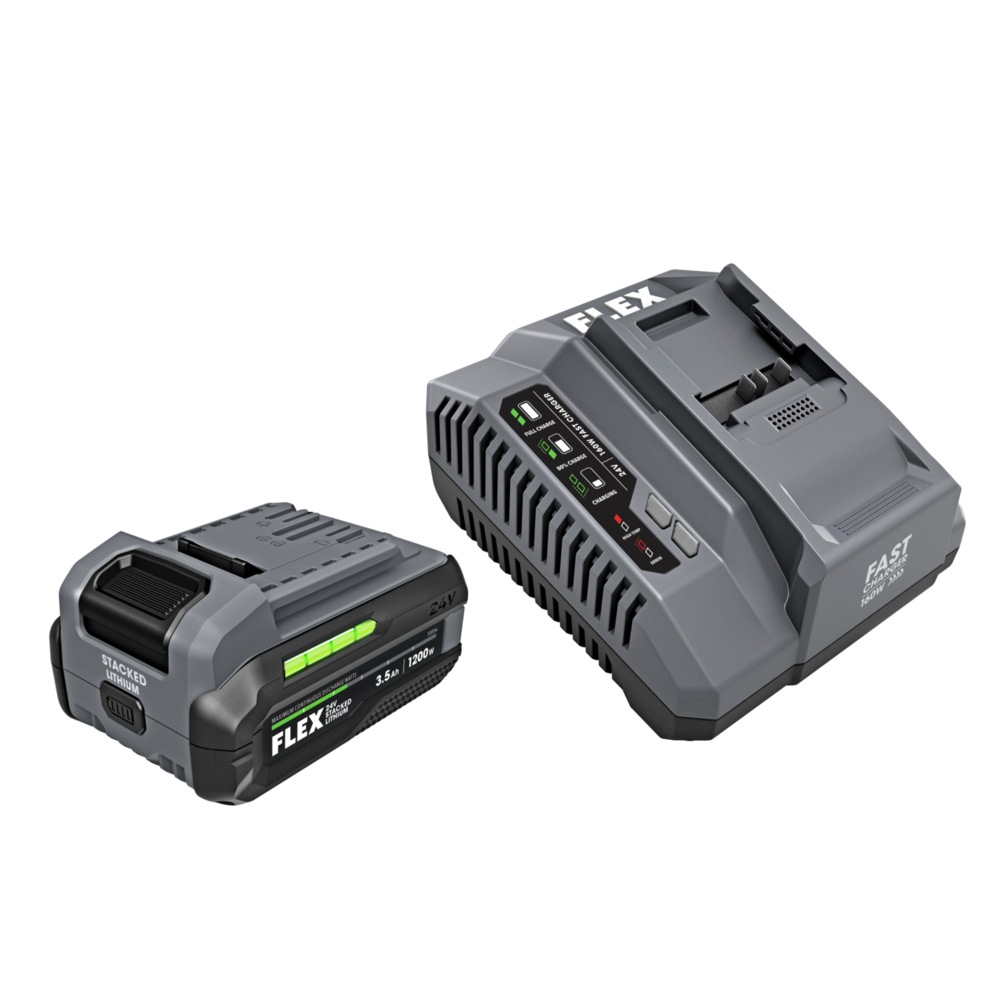
The official FX0411-1F starter kit lists a 24V 3.5Ah Stacked Lithium battery and a 160W fast charger. It is a battery-and-charger package, not a drill-and-driver combination. The charger specifications on that page state 120V, 60Hz input.
This illustrates two common purchasing errors: interpreting “starter kit” as a complete working tool set, and assuming an overseas charger suits the local electricity supply. Resolve both from the included-items list and rating plate before treating a discount as a saving.
How a professional would shortlist FLEX tools
1. Define the job before choosing the model
Write down the material, required accessory size, access restrictions, and expected frequency of use. “A drill for installation work” is too broad. “A compact drill for repeated cabinet assembly in confined spaces” creates a much more useful shortlist. A maximum-output specification may matter less than control, reach, and working weight for that job.
2. Evaluate the tool with its intended battery
Compare the complete working configuration. A tool-only weight excludes the battery you will carry throughout the task. Request the installed weight, overall dimensions, and recommended battery for the application. If you can handle a demonstration unit, assess balance and control with the pack you actually plan to buy.
3. Separate compatibility from optimal performance
A compatible battery answers whether an approved combination can operate. It does not, by itself, establish equal runtime or output across every pack in that platform. Look for model-specific guidance and tests that disclose the battery used. A result obtained with a different pack may not represent the kit in your shopping cart.
4. Compare equivalent tasks, not isolated headline numbers
A credible comparison specifies the tool model, battery, accessory, material, and operating conditions. For drilling, useful measures include repeatable completion time and control. For cutting, include cut quality and repeated-work performance. For polishing, consider finish quality and controllability. A single peak specification cannot settle all of these questions.
5. Check the next purchase
List the next two tools you realistically expect to add. Confirm that suitable models, replacement batteries, and service are available in your region. A discounted first tool is less attractive if the system cannot support the work that follows. For a broader framework, see our cordless power tools and battery-platform guide.
Stacked Lithium: what should influence the buying decision?
FLEX promotes Stacked Lithium in its North American 24V range, including battery management and thermal-management features. These are manufacturer descriptions, not independent findings from this article. The useful buying question is whether the specific battery-and-tool combination improves your actual work enough to justify its cost and weight.
When evaluating a claim about more power, faster charging, or longer battery life, identify the comparison battery and test conditions. Also distinguish battery service life from runtime per charge. A percentage about lifetime should not be read as an equivalent increase in minutes of work.
For occasional, short tasks, a premium pack may offer limited practical value. For frequent demanding work, a suitable higher-performance pack may deserve closer evaluation. Confirm that with an application-relevant demonstration or a well-documented independent test rather than extrapolating from a platform-wide slogan.
Compare FLEX kits by usable configuration
| Comparison item | Question worth asking | Why it matters |
|---|---|---|
| Tool models | What are the full model numbers, including kit suffixes? | Similar names can conceal different tools or package contents. |
| Batteries | How many packs, which models, and what capacities? | A piece count does not explain how long the setup can support your work. |
| Charger | Which model and input rating are included? | Charging arrangements and regional electrical compatibility affect usability. |
| Working configuration | What is the weight with the planned battery? | Tool-only figures can hide an important ergonomic difference. |
| Accessories | Are the needed bits, blades, or other consumables included? | A low starting price can omit necessary working items. |
| Support | Who handles repairs and what documentation is required? | Service access affects the practical cost of ownership. |
Do not compare a bare-tool price with a complete kit price. First build two lists that can perform the same work. Include any batteries, charger, accessories, and storage you would otherwise have to purchase separately.
A practical total-cost calculation
Ready-to-work cost = tools + required batteries + charger + essential accessories + delivery and applicable charges. For a professional business, also consider expected interruption costs and replacement availability. Keep assumptions visible instead of presenting speculative savings as facts.
Consider a hypothetical crew choosing between one large battery and two smaller approved packs. If charging is available during normal breaks, rotation may be useful. If work happens far from power, the priority may be carrying enough stored energy. Neither approach is universally better; the schedule and task decide.
For occasional home projects, avoiding an unnecessary second platform may be more valuable than a small specification advantage. For a working trade, dependable access to a spare battery or repair service may outweigh a modest initial discount. These are purchasing judgments to apply to your circumstances, not measured rankings of FLEX against competing brands.
Warranty and buying-channel checks
Read the current North American warranty terms or the terms for your own market before buying. Check product eligibility, registration deadlines, proof-of-purchase requirements, exclusions, and where service is provided. Do not assume a historic promotion or a warranty described in an older review applies to a new purchase.
Keep the invoice and exact model details. For marketplace or cross-border purchases, clarify the seller’s identity, returns process, and local support arrangements in writing. A familiar logo in a listing does not answer these questions.
FLEX power tools FAQ
Are all FLEX batteries interchangeable?
Do not assume that. The North American compatibility statement applies to FLEX 24V tools and chargers. The UK site also has separate 12V and 18V systems. Verify the exact tool-and-battery combination in the relevant official documentation.
Are FLEX power tools a good choice for professionals?
They are worth evaluating when the local range includes the tools your trade needs. A sound decision depends on the exact model, working configuration, task performance, and support access. This guide does not establish a universal winner or claim hands-on durability results.
Should I choose a bare tool or a kit?
A bare tool can make sense if you already own suitable approved batteries and a charger. For a first purchase, price a complete working setup. Read the included-items list: “starter kit” may mean batteries and a charger without a power tool.
Does a higher voltage number prove better performance?
No. A voltage label alone does not describe the tool’s complete performance. Compare application-relevant results for the exact configurations, and check how each manufacturer specifies voltage before making a numerical comparison.
Which FLEX tool should I buy first?
Start with the tool that solves your most frequent task, then confirm that its platform supports likely future purchases. Avoid choosing a large combo kit solely because it contains more pieces. Our tool set buying guide explains how to evaluate useful coverage and duplication.
Final checklist before choosing FLEX power tools
Confirm the regional platform, exact model numbers, approved battery combination, charger input, complete package contents, and local service terms. Then compare the working configuration against the task that matters most to you. The best purchase of FLEX power tools is a coherent setup that fits your workload and budget, with a clear path to the tools and support you will need next.