
Pro tools should be evaluated against repeated work, verifiable performance and the consequences of interruption. For professional hand-tool buyers, a higher purchase price makes sense only when a relevant benefit is supported: the tool fits the job better, maintains the required performance or can be restored to service with less disruption.
This article covers professional hand tools for industrial buyers, distributors and private-label brands. It does not cover Avid’s Pro Tools audio software. It focuses on duty, handling and lifetime economics; use our tool set guide for contents selection and case configuration.
Define professional duty with a workload
“Professional” is not a test method. Describe the task, frequency, load conditions, work environment and consequence of a tool becoming unavailable. Two users can own the same tool but expose it to very different service demands.
Illustrative workload comparison: assume ten fastening operations per job. The figures below are invented planning inputs, not industry averages or fatigue-test cycles.
| Workload input | Occasional-use scenario | Service-work scenario |
|---|---|---|
| Jobs | 1 per month | 5 per workday |
| Scheduled workdays | Not applicable | 20 per month |
| Jobs per year | 12 | 1,200 |
| Fastening operations per year | 120 | 12,000 |
The service scenario contains 100 times as many operations. That arithmetic does not prove 100 times the wear, a required tool life or a brand’s suitability. Load level, technique, access, contamination and the tool’s construction still matter. It explains why an occasional-use evaluation cannot automatically answer a repeated-use purchasing question.
State what happens if the tool is unavailable. A technician with a nearby approved spare has a different interruption cost from a field-service worker who must leave the site. Build the professional requirement around that context rather than a premium finish or a “heavy duty” label.
Ask what each type of evidence actually proves
| Evidence | Useful purchasing conclusion | Conclusion it cannot establish alone |
|---|---|---|
| Dimensioned drawing and fit trial | The specified geometry can suit the application | Long-term durability |
| Applicable proof-load result | The tested specimen met the stated one-time requirement | Unlimited working torque or repeated-use life |
| Defined cyclic or endurance evaluation | Performance under that recorded sequence and load | Life under every field condition |
| Service and claims records | Observed problems in the recorded population | A fair comparison when exposure or usage differs |
| Written repair or replacement arrangement | The promised route back to service | An automatic guarantee of no downtime |
For socket systems, ASME B107.110 identifies a relevant performance-and-safety standard family. Ask the supplier to connect the applicable edition and requirements to the exact model. A material abbreviation or a factory’s general quality certificate cannot replace product evidence.
Where endurance matters, agree an evaluation suitable for the product with the manufacturer or a qualified laboratory. Record the load, cycle definition, fixture, operating method, sample identity and failure criteria. Do not invent one cycle target for every wrench, plier or ratchet. The functional-strength testing guide explains the separate test questions in more detail.
Handling matters before the first failure
Professional use also involves repeated gripping and repositioning. The NIOSH and Cal/OSHA guide to selecting non-powered hand tools emphasizes matching the tool to the task, hand and working space. Its single-handle guidance distinguishes power-grip tasks from precision tasks:
| Single-handle task in the guide | Handle-diameter guidance | Approximate metric conversion |
|---|---|---|
| Power tasks | 1¼–2 in | 32–51 mm |
| Precision tasks | ¼–½ in | 6–13 mm |
Source: the guide’s single-handle selection guidance. These are screening ranges, not universal product dimensions or specifications for every hand-tool shape. They should not be transferred directly to plier grip spans or wrench handles. Use the full guidance and trial the actual tool for the task and user.
During a practical comparison, keep the workpiece, gloves and task conditions consistent. Observe grip comfort, access, readable identification and any need to repeatedly reposition the tool or the operator. Record where a design works better or worse instead of assigning a generic “ergonomic” score. Do not turn a short handling trial into a claimed reduction in injury rates.
Calculate the cost of an interruption
A simple one-year economic model is: acquisition cost + expected disruptions × cost per disruption. Expand it when repairs, scheduled maintenance or replacement purchases are relevant. Keep each cost in one place so that replacement cash is not included twice.
Hypothetical example: compare two unnamed tools that already satisfy the required application and performance conditions. Assume each disruption takes 25 minutes, productive time is valued at $36 per hour, and direct non-labor expense is $10 per disruption. The direct expense may include the assumed net replacement or handling cost; do not add it again elsewhere.
| Per-tool, one-year assumption | Option A | Option B |
|---|---|---|
| Acquisition cost | $40 | $65 |
| Assumed disruptions | 4 | 1 |
| Time value per disruption | 25/60 × $36 = $15 | $15 |
| Direct non-labor cost per disruption | $10 | $10 |
| Total cost per disruption | $25 | $25 |
| Modeled annual economic cost | $40 + 4 × $25 = $140 | $65 + 1 × $25 = $90 |
Under these assumptions, Option B has a $50 lower annual economic cost despite costing $25 more to buy. The prices and disruption frequencies are illustrative, not supplier quotations, observed defect rates or a forecast. A higher price does not establish fewer disruptions; that assumption needs evidence from a relevant trial or service records.
Time value is not automatically a cash saving. If the same labor cost will be paid regardless and the recovered time produces no additional useful work, the cash case differs. Using only acquisition and the assumed $10 direct expense, the totals would be $80 for A and $75 for B. Show both views when the investment decision depends on the distinction.
Find the break-even point before paying the premium
In the economic model, the premium is $65 − $40 = $25. At $25 per avoided disruption, avoiding one event reaches break-even; more than one creates a modeled benefit.
| Disruptions avoided per year | Avoided economic cost | Net benefit after $25 premium |
|---|---|---|
| 0 | $0 | −$25 |
| 1 | $25 | $0 |
| 2 | $50 | +$25 |
| 3 | $75 | +$50 |
This sensitivity table makes the purchasing assumption visible. If the interruption cost is lower, more events must be avoided. If an approved spare removes most downtime, the case for the premium may weaken. Safety and mandatory performance requirements remain requirements; they should never be traded away for a favorable cost calculation.
For distributors, use claims cost rather than technician downtime
A reseller usually needs a different calculation: net sales revenue − landed cost − selling costs − expected claims cost. Do not import the end user’s time savings into your own profit unless your business actually captures that value.
For example, assume an alternative costs $2 more per unit and the fully loaded cost of an eligible claim is $40. With all other factors unchanged, it needs an expected claim-rate reduction of $2 ÷ $40 = 0.05, or five percentage points, just to offset the premium. An assumed reduction from 8% to 3% meets that threshold; it is not a claim about any actual product.
Use your own claim frequency, freight, handling and net replacement expenses. A warranty may reduce one expense while leaving administrative work or transport costs with the distributor. If reliable history is unavailable, compare scenarios and label the uncertainty rather than assigning the more expensive product a lower defect rate.
Treat support as an operating arrangement
| Support issue | Question to resolve |
|---|---|
| Coverage | Which failures, exclusions and product models are covered? |
| Evidence | What photographs, identification or inspection are required? |
| Transport | Who pays collection, return and replacement freight? |
| Return to service | Is there a local spare, repair route or replacement lead time? |
| Continuity | Will replacement components remain compatible with the installed range? |
A lifetime warranty and an immediately available replacement are different benefits. Confirm the provider’s current terms for the buying channel and market. For a private-label range, define who handles the end customer, who approves the claim and how stock is supplied; do not make a support promise before the arrangement exists.
Use a field pilot to reduce the important uncertainty
- Select representative tasks and users rather than only the easiest demonstration.
- Record tool identity, start date and a practical measure of exposure such as completed jobs.
- Separate misuse, loss, application mismatch and product faults.
- Record interruptions, repair time, replacement expense and unresolved cases.
- Compare candidates under reasonably similar exposure and keep the sample size visible.
A short pilot with no failures is useful evidence of initial fit and usability; it is not proof of a zero long-term failure rate. If one tool completed more work, compare the exposure before comparing incident totals. Keep the pilot’s conclusions limited to what was actually observed.
Use the results to decide whether the premium is justified, whether a spare is needed or whether the application requires a different tool. For broader supplier qualification and order documentation, refer to the manufacturer selection checklist rather than repeating that entire workflow here.
Frequently asked questions
Are more expensive pro tools always worth buying?
Only when verified task fit, performance, handling or support creates enough value for the buyer. Calculate the break-even benefit and investigate the assumption that drives it.
Does passing a proof-load test prove long service life?
No. A proof-load result concerns the stated test and specimen. Repeated-use performance requires evidence appropriate to the intended duty and conditions.
How should a new brand estimate warranty cost?
Use actual costs and relevant service history where available. Otherwise use clearly labeled scenarios, then replace the assumptions with recorded claims and exposure data as the range develops.
Can a tool kit’s piece count establish professional suitability?
No. Configuration and professional duty are different questions. Check the kit’s task coverage separately from performance, repeated-use handling and support.
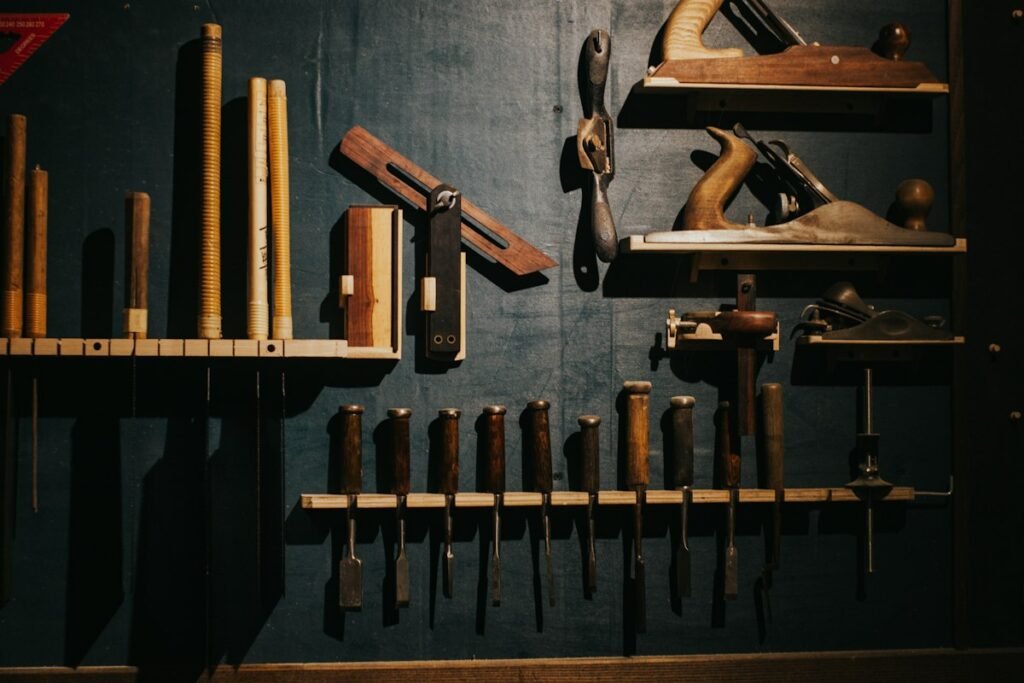
Workshop photograph: Minh Đức on Unsplash. Illustrative image; it does not represent a tested product range.
Choose pro tools with a defensible service case
A credible range of pro tools connects the customer’s workload to product evidence and a workable route back to service. Use an explicit cost model, test its assumptions and retain the observed results. Share your intended duty, performance requirements, quantities and support expectations with Nexus ToolPal to discuss a professional hand-tool project.