
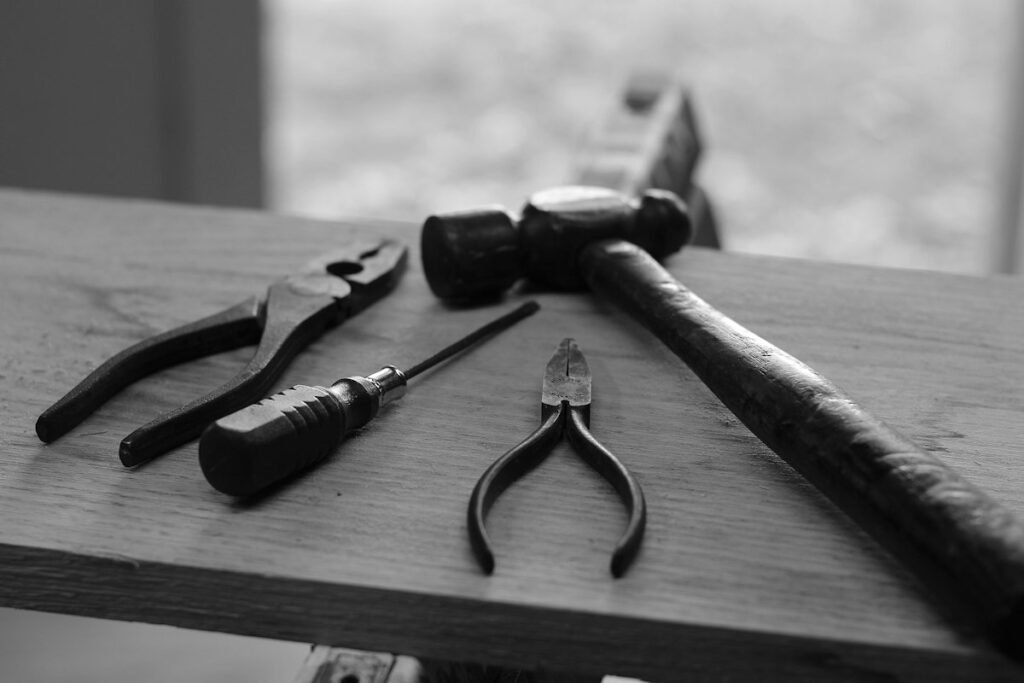
Manual hand tools are tools operated by human effort to fasten, grip, cut, shape, strike, hold or measure. Screwdrivers, wrenches, pliers, hammers, files, hand saws and clamps are common examples.
Understanding the types of hand tools and their uses helps hardware importers, distributors and private-label buyers match a product to a customer’s work. Effective hand tool selection goes beyond naming the category: confirm the workpiece, working capacity, access and intended duty before comparing prices.
Photo: Hunter Haley on Unsplash. General hand-tool illustration.
Types of Hand Tools and Their Uses at a Glance
These seven functional groups provide a practical starting point. Some tools perform more than one function; classify them by the job the customer needs to complete.
| Tool family and examples | Typical uses | Key selection checks |
|---|---|---|
| Fastening: screwdrivers, hex keys, wrenches and sockets with manual handles | Turn matching screws, nuts and bolts. | Fastener profile and size, approach direction, reach and handle clearance. |
| Gripping and bending: combination, long-nose and tongue-and-groove pliers | Hold, position or bend suitable workpieces. | Jaw shape and opening, workpiece material and surface marking. |
| Cutting: diagonal cutters, snips, hand saws and utility knives | Cut specified wire, sheet, wood or packaging. | Material and thickness or diameter, rated capacity, blade type and replacement availability. |
| Shaping and finishing: files, rasps and scrapers | Remove material, refine profiles and finish edges. | Workpiece material, profile, working length and cut or coarseness. |
| Striking: claw hammers, ball-peen hammers and mallets | Drive or remove nails, work metal or deliver suitable assembly blows. | Intended striking task, head and face material, mass and handle attachment. |
| Holding: clamps and bench vises | Secure workpieces while another operation is performed. | Opening, throat depth, contact pads and mounting arrangement. |
| Measuring and layout: tape measures, rules, squares and spirit levels | Check dimensions, mark work and establish alignment. | Range, units, readability, stated accuracy and relevant calibration requirements. |
For example, pliers can grip a part, but a suitable clamp or vise may be needed to keep it secured during cutting. Similarly, a gripping jaw does not automatically provide a cutting function. Confirm the actual design and documented capability.
Hand Tool Selection: Follow Five Decisions
- Define the operation. Replace “maintenance tool” with a specific task: turn a fastener, cut a material, hold a workpiece or check alignment.
- Identify the interface or material. Record the screw recess, nut size, workpiece shape or material to be cut. These requirements eliminate unsuitable tool families early.
- Check access. Confirm approach direction, available head clearance, reach and handle movement. The correct nominal size can still be unusable in the available space.
- Assess the user and duty. Consider operating frequency, force, gloves, working posture and environment. Compare suitable handle and tool configurations under representative conditions.
- Document and verify the choice. Put the required dimensions and capacities in the quotation, then check an identified sample on the intended task before approving the specification.
Price becomes meaningful after the required fit and function are established. A lower-cost tool that cannot reach the fastener is not an equivalent alternative. Avoid accepting “professional quality” as a substitute for missing dimensions or performance requirements.
Choose the Configuration Within Each Tool Family
Wrenches and Sockets: Match the Fastener and the Space
An open-end wrench, a box-end wrench and a socket offer different access arrangements. Check whether the tool can approach axially, whether a projecting stud needs clearance and whether the handle can move through its working arc.
Keep the interfaces separate: “3/8-inch drive, 13 mm socket” identifies a square-drive connection and a fastener opening. They are different dimensions. Use our 3/8 socket set guide for socket depth and fit, or the socket ratchet buying guide for handle length and access.
Pliers and Cutters: Specify Jaw Function and Material Capacity
Long-nose pliers can provide access to small parts, while other jaw forms suit different gripping tasks. A longer nose does not establish greater gripping strength. For locking tools, compare the workpiece shape using the curved versus straight jaw guide.
For cutters, a diameter without a material specification is incomplete. Soft wire and hardened wire may have different permitted capacities. CCOHS guidance on pliers and wire cutters advises using a tool specifically designed for hardened wire when that material must be cut.
Files, Rasps and Saws: Match the Cutting Form to the Work
Choose the profile and cutting form for the material, stock removal and finish required. Flat faces, internal curves and narrow openings need different shapes. For files, confirm whether the stated length means the working portion or the overall tool; for saws and replaceable-blade tools, identify the compatible replacement format.
Two Selection Examples for Wholesale Buyers
Confined equipment maintenance: a request for “a tool for a 13 mm nut” does not settle the configuration. Check side access, axial clearance, projecting stud length and room to swing the handle. These answers may lead to a wrench, a deeper socket or a different handle arrangement. Confirm the assembly’s actual clearance with a sample.
Holding finished round tubing: jaw geometry, diameter and acceptable surface marking matter together. A serrated gripping jaw may mark the finish; evaluate suitable protective contacts or a workholding device for the actual operation. A tool advertised only by overall length leaves the buyer without enough information.
Five Specification Mistakes That Cause Wrong Purchases
- Overall length versus capacity: a 200 mm tool length does not establish jaw opening or usable reach. For an adjustable wrench, confirm length, jaw capacity and access separately.
- Ratchet versus torque wrench: a ratcheting mechanism alone does not provide a specified torque setting or measurement function.
- Grip covering versus electrical insulation: plastic or rubber grips alone do not establish suitability for electrical work. Require the appropriate documented product rating and working procedure.
- Resolution versus accuracy: finer graduations or extra display digits do not prove a more accurate measuring tool.
- Material label versus performance: a steel abbreviation does not establish finished-tool strength. Define the relevant product requirement and request supporting evidence.
Evaluate Handling, Instructions and Sample Fit
The Canadian Centre for Occupational Health and Safety’s tool-design guidance connects tool fit with the task, workstation and wrist position. Review grip span, balance, reach and pressure points with representative users and the gloves required for the work.
For frequent forceful operations, assess whether a powered option is appropriate, including its weight and other hazards. Manual hand tools are useful where their operating method fits the job; repeated effort still needs evaluation.
Request instructions, maintenance information and replacement-part details where relevant. CCOHS general hand-tool guidance recommends selecting the correct tool, inspecting its condition and maintaining and storing it properly. Check whether these requirements are clearly communicated with the product.
Turn the Selection into a Clear Purchasing Brief
For each SKU, record tool type, intended use, exact size or capacity, interface, access dimensions, material or finish requirements, and the agreed verification method. Add included accessories and replacement formats where applicable. Keep these attributes consistent across quotations, packaging and product listings.
Use the hand-tool RFQ checklist to structure supplier enquiries. For complete kit contents, follow our tool set buying guide; for repeated-use performance and support costs, see the professional hand tools guide.
Frequently Asked Questions
What type of hand tools should a distributor stock first?
Start with the operations requested by the intended customers, then confirm their sizes, materials and access needs. Household assembly, workshop service and fabrication lead to different selections. Use customer enquiries and sales records to validate the starting range.
Are manual hand tools the same as handheld power tools?
No. In this guide, manual hand tools use human effort; an electric drill remains a power tool even when held in the hand. See the hand and power tool terminology guide for the distinction.
Should a buyer choose the longest tool available?
No. Greater length can change reach and leverage, but also clearance, balance and handling. Select a suitable configuration within its intended use, rather than treating length as a quality grade.
What information is needed before requesting a quotation?
Provide the task, workpiece or fastener, required sizes, working space, target market and quantities. Include drawings or photos when access is difficult, and state any required testing or documentation.
Select Hand Tools Around the Customer’s Work
Understanding the types of hand tools and their uses turns a broad product list into practical choices. Good hand tool selection connects function, fit, capacity and verified requirements. Explore the Nexus ToolPal product range or send your applications, sizes, target market and quantities to discuss suitable sourcing options.