
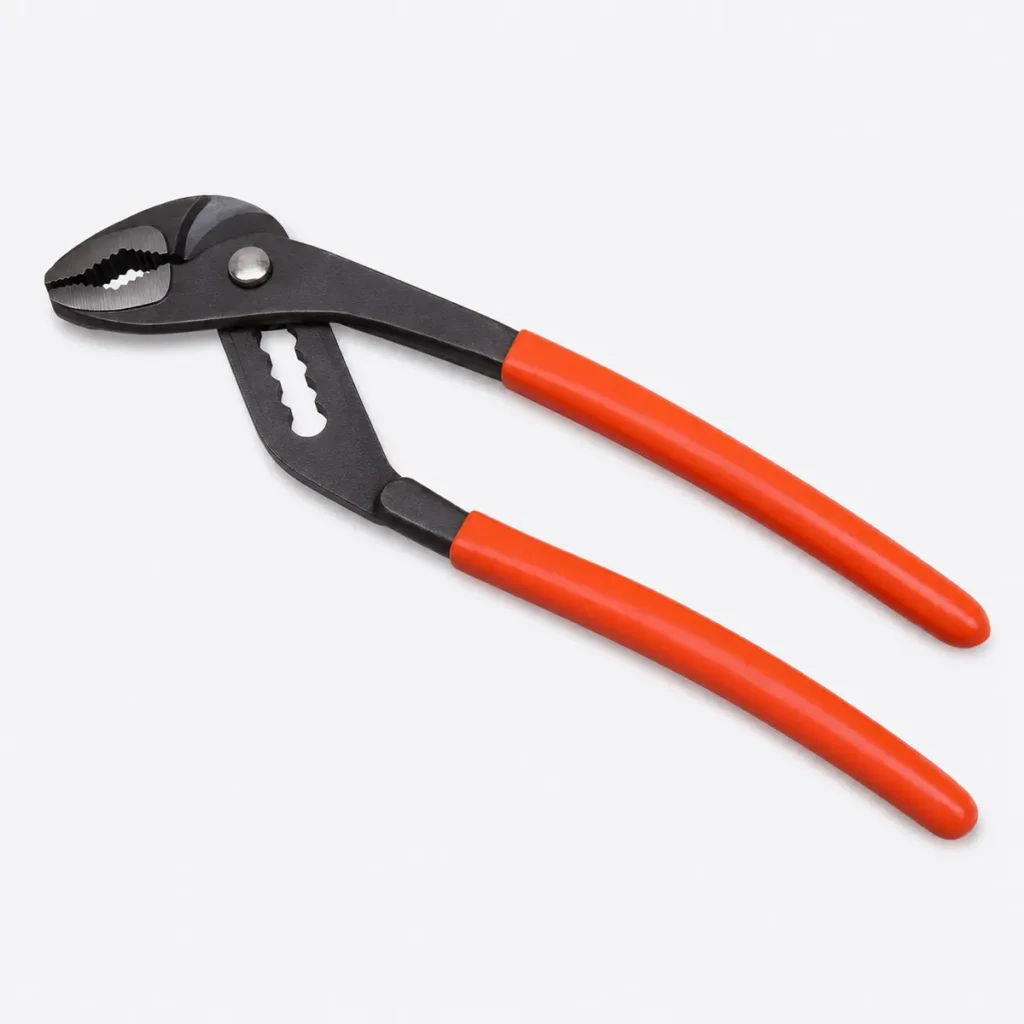
Choosing water pump pliers vs slip joint pliers starts with the parts the customer handles. Water pump pliers are a useful starting point for varied round sections and larger gripping tasks that benefit from multiple jaw settings. Conventional slip joint pliers suit general gripping, holding and bending where their simpler adjustment and head layout fit the job. A maintenance kit can justify both; a plumbing kit may need a different combination.
For ordinary serviceable nuts and bolts, specify the correct wrench or socket. Serrated pliers can mark surfaces and round corners, even when their jaws open far enough. The purchasing decision should separate gripping capacity, usable hand position, access and the fastening procedure.
This guide focuses on adjustable, non-locking pliers for plumbing and maintenance buyers. For a tool that locks onto the work, see our locking-plier jaw selection guide. The adjustment mechanisms discussed here do not automatically provide a locking-clamp function.
Identify the adjustment mechanism before comparing names
A conventional slip joint plier shifts its pivot between a small number of settings, commonly two. Its combination gripping area often includes a serrated front section and a recessed pipe-gripping section. It remains useful across several small handling tasks, provided the selected setting gives stable contact and a manageable grip.
Water pump pliers commonly use an angled head with several adjustment positions. Tongue-and-groove patterns select a groove; push-button patterns use a release and engagement mechanism. Finer adjustment can bring the handles into a more usable position on intermediate workpiece sizes. It does not automatically increase maximum capacity.
Catalog terminology varies. “Groove joint,” “tongue and groove” and “water pump” may overlap, while some suppliers use “slip joint” broadly for adjustable pliers. Ask for the exact model and joint drawing. “Box joint” describes joint construction; it does not by itself declare the adjustment count, pipe capacity or suitability for a particular fitting.

Equal tool length can hide important differences
Compare two identifiable 8-inch models: the CHANNELLOCK 528 slip joint plier and the CHANNELLOCK 428 straight-jaw tongue-and-groove plier. Their official pages list the same overall length, but different joint dimensions and weights.
| Published field | 528 — slip joint | 428 — tongue and groove |
|---|---|---|
| Overall length | 203.2 mm / 8.0 in | 203.2 mm / 8.0 in |
| Joint thickness | 9.14 mm / 0.36 in | 10.16 mm / 0.40 in |
| Catalog weight | 263.08 g / 0.58 lb | 358.34 g / 0.79 lb |
| Jaw capacity | Not stated in the referenced technical table | 38.1 mm / 1.5 in |
The 1.02 mm difference in joint thickness matters if that part of the tool must pass an obstruction. It does not describe jaw-tip thickness. The listed weight also gives a buyer something concrete to assess for a carried service kit; neither number establishes which tool grips better.
Check the field label: the 528 page lists a 29.72 mm / 1.17 in joint width. That dimension must not be copied into a jaw-capacity column. An opening omitted from a technical table remains a supplier question; a neighboring dimension cannot fill the gap.
Adjustment count needs similar care. The 528 specifies two positions. The separate 428X push-button model specifies nine positions and a 30.5 mm jaw capacity, whereas the conventional 428 above lists 38.1 mm capacity. These are different designs: more settings can improve size matching without producing a larger opening. They are not a controlled performance comparison.
Read capacity by workpiece shape and actual diameter
The KNIPEX 87 01 250 SB product sheet provides a clear example of shape-specific data. It lists a 250 mm tool length, 25 adjustment positions, Ø50 mm capacity for pipes and 46 mm capacity for nuts. A round diameter and a hexagonal opening describe different contact geometries; they should occupy separate fields in a purchasing specification.
A useful inquiry therefore identifies the outside diameter for a round part, or the width across opposing flats for a hexagonal part. Add the material, wall thickness where relevant, acceptable tooth marks and the intended operation. None of these capacity figures is an allowable torque or permission to grip a delicate surface.
The nominal-pipe-size trap
A catalog’s “2-inch pipe capacity” needs its dimensional definition checked. Charlotte Pipe’s Schedule 40 pipe table lists its nominal 2-inch PVC 4020B pipe with a 2.375-inch average outside diameter—approximately 60.3 mm. That is a different dimension from the KNIPEX sheet’s stated Ø50 mm gripping limit.
Consequently, a Ø50 mm capacity does not pass the opening screen for that 60.3 mm outside diameter. The conversion is 2.375 × 25.4 = 60.325 mm, rounded above. This is a dimensional illustration, not a recommendation to use serrated pliers on PVC. Plastic pipe, fittings and decorative components require the maker’s approved handling and installation method.
Use the actual pipe or fitting drawing when selecting tools. Nominal pipe size, pipe outside diameter and a fitting’s hexagon width can all differ within one assembly.
When the two types complement each other
Evaluate a proposed pair against the customer’s work sequence. A second tool earns its place when it supplies a useful gripping layout, size range or access position that the first tool does not handle well. Simply supplying two adjustable tools does not establish complementary coverage.
| Customer workload | Useful starting selection | Reason to confirm it |
|---|---|---|
| Mixed repair: small parts plus larger round components | Slip joint pliers plus water pump pliers | Check the slip joint on small handling tasks and the water pump pliers across the required larger diameters. |
| Two round components need holding and turning | Two suitably sized gripping tools, potentially two water pump pliers | Both sides need adequate capacity, contact and movement; a small slip joint may be insufficient. |
| A round body must be held while a hex nut turns | An approved gripping tool plus a correctly fitted wrench | Each tool addresses a different contact surface; check where the component may safely be held. |
| Most work involves accessible nuts and bolts | Suitable wrenches or sockets, with pliers for separate handling tasks | The fastening requirement should determine the primary tools. |
For a mixed maintenance assortment, the shorter or lighter slip joint tool may be convenient for holding a small bracket, manipulating a suitable pin or bending material within its intended use. The water pump plier may cover larger or more varied round parts. Demonstrate those jobs on samples rather than assuming every slip joint head is more compact or every water pump plier is more capable.
For a plumbing specialist, two water pump pliers of appropriate sizes may cover a holding-and-turning operation better than a fixed “one of each” bundle. Conversely, if one selected model completes all required gripping tasks, the second type may add little useful coverage. Any counterholding arrangement must use locations and methods permitted by the component manufacturer.
When to select a wrench or another tool
CCOHS pliers guidance specifically advises using a wrench on nuts and bolts because pliers can round their corners. For routine work on sound hex fasteners, choose a correctly fitted wrench or socket and follow the equipment procedure. Our adjustable wrench sizes guide explains the opening and seating checks for an adjustable wrench.
Some water pump pliers are explicitly designed and marketed to grip nuts, as the KNIPEX sheet illustrates. That is a model-specific intended application, not a reason to treat every toothed plier as a general wrench replacement. Consider the required contact, surface condition, access and the consequences of marking or rounding. A stated nut capacity alone does not resolve those questions.
- Decorative or finished fittings: use a suitable smooth-jaw or other manufacturer-approved tool. A purpose-designed pliers wrench with smooth parallel jaws is a separate tool type; do not infer its behavior from a serrated water pump plier.
- Thin-wall, soft or plastic components: opening fit alone cannot rule out crushing, scoring or distortion. Use the component maker’s specified handling method and gripping location.
- Specified tightening torque: use the appropriate torque-controlled tool and procedure. Grip force and handle length do not provide a tightening measurement.
- Demanding pipe turning: select a tool intended for the pipe material and task. A suitable pipe wrench may be appropriate for robust pipe where tooth marks are acceptable.
KNIPEX’s tool-selection explanation distinguishes its toothed Cobra water pump pliers from its smooth-jaw pliers wrench. For pipe-wrench selection, CCOHS pipe-tool guidance calls for sufficient capacity and leverage and warns against using pipe wrenches on nuts and bolts. A pipe wrench is not a universal solution for every plumbing surface.
Compare the exact Nexus ToolPal configuration
The following are selected published entries from our WS-20 water pump pliers, WS-06 water pump pliers and WL-02 slip joint pliers. All three carry a 10-inch catalog size, which illustrates why an inch label alone leaves important purchasing questions unanswered.
| Model / tool type | Published full length | Published opening |
|---|---|---|
| WS-20-10 — water pump pliers | 240 mm | 40 mm |
| WS-06-10 — water pump pliers with screwdriver tip | 250 mm | 38 mm |
| WL-02-10 — two-position slip joint pliers | 245 mm | Not listed on the product page |
The two water pump entries differ by 2 mm in stated opening despite sharing the same nominal size. Their openings require confirmation against the intended workpiece shape and the agreed measurement method. The WL-02 listing establishes two adjustment positions and overall length; it does not establish a maximum gripping diameter. Request that missing dimension before approving coverage or publishing a capacity claim.
Likewise, a slotted screwdriver tip is an additional function on WS-06-10, not evidence of greater gripping capacity. Keep such a feature only when the customer needs it and the relevant dimensions and use are confirmed. These Nexus ToolPal entries are separate catalog references, with no claim of equivalence to the external manufacturer examples.
Approve a pair on representative parts
A purchasing engineer should be able to explain which task each tool completes and what observation supports the choice. Use a small, repeatable application trial before approving the assortment:
- Select the working sizes. Include the smallest required part, a typical intermediate size and the largest actual diameter or thickness. Test the real material and relevant finish.
- Set the joint for each part. Check full engagement, jaw contact and whether the handles allow a controlled grip. Record whether an intermediate size leaves the handles awkwardly spread.
- Reproduce the access. Include nearby walls, adjacent fittings and the required hand space. For a two-tool operation, place both tools on the assembly together.
- Inspect the result. Look for slipping, joint movement, tooth marks and distortion under the agreed task. A part that fits between open jaws has passed only the first screen.
- Document the boundary. Keep the approved model, workpiece dimensions, permitted use and unacceptable damage with the sample record. Obtain model-specific performance evidence separately where it is required.
Do not turn catalog adjustment count into a load rating or claim an endurance result from a short application trial. Dipped comfort handles also do not establish electrical insulation. Follow the maker’s instructions, keep the joint and gripping surfaces serviceable, and avoid handle extensions.
Frequently asked questions
Can water pump pliers replace slip joint pliers?
Sometimes one model can cover the required gripping tasks. Check small-part control, head access, handle position and the actual size range. Keep both when each completes a useful task; a plumbing operation may instead justify two suitably sized water pump pliers.
Does a 10-inch plier have a standard capacity?
No. The inch label describes a tool size class. The two Nexus ToolPal water pump examples above list 38 mm and 40 mm openings. Compare the exact model, capacity definition and workpiece shape.
Do more adjustment positions mean a stronger grip?
More positions can help match jaw spacing and hand position to the part. They do not establish load capacity, endurance or the maximum opening. Evaluate the actual design and its supporting evidence.
Sources checked October 25, 2026. Dimensions and features are manufacturer-published data; the pipe conversion is calculated. This is a specification-based purchasing guide, not a hands-on performance test. External examples illustrate tool differences and do not establish certification or performance for Nexus ToolPal products.
Select the pair around the customer’s actual work
The useful decision in water pump pliers vs slip joint pliers is whether the selected tools cover distinct gripping tasks with suitable contact, hand position and access. Verify actual diameters and model-specific capacities, then use the appropriate wrench for ordinary hex-fastener work. Send Nexus ToolPal your workpiece sizes, materials, acceptable surface marking, required tool combination and quantities to discuss a plumbing or maintenance assortment built around those requirements.